During my years as a high school sports reporter, I would cover games in towns without really investing too much into the towns themselves.
One of those towns was Streator, whose high school’s athletic conference from 1958 to 2012 was the North Central Illinois Conference (NCIC) – the same as Sterling and Rock Falls’ back home. I can only count on one hand how many games I’ve covered there over a nearly 25-year journalism career, but such trips only involved going to the high school. In recent years, I’ve had an increased interest in local history, and I visited town to see the things that I had previously just drove past.
What drew me to Streator was its vast railroad history. As late as the 1960s, Streator had five Class 1 railroads go through it: the Chicago, Burlington and Quincy; Santa Fe; New York Central; Gulf, Mobile and Ohio; and Wabash railroads. This number is now just three, as the NYC is now the Norfolk Southern, one of the CB&Q lines is now the Illinois Terminal, and the Santa Fe merged with Burlington Northern (the “B” in CB&Q) to form BNSF 30 years ago. Most towns don’t have any more than three Class 1 railroads go through it, but Streator had five – and that meant there was lots of manufacturing, and perhaps history, once here.
So off I went …
I took the way our athletic team buses would always take, entering town from the west on state Route 18. One of the notable sights that I would see from the bus was the tall steeple of a Catholic Church on the side of the road. This once was Annunciation of the Blessed Virgin Mary Church (also known as the Eagle Church). The parish was merged into Sts. Peter and Paul Parish of nearby Leonore at the start of 2014. The church was built in 1924. The building sat closed off when I drove past, and it appeared as if the parsonage is now a private home. There has been a lot of Catholic Church consolidation in the area, as I also saw the final days of the Immaculate Conception Church in town; it was being razed that weekend.
Streator’s National Guard Armory building on the west edge of town is no longer a military matter. It closed a decade ago, but it is now a small business incubator. The exterior is Art Deco, and two concrete eagles flank the front door. A journalism friend of mine is now its general manager.

One of my first stops in town was what I call “railroad spaghetti,” a collection of tracks where four of the five aforementioned railroads went through. The CB&Q stopped both tracks at the former Owens glass plant, at one time one of the largest glass operations in the world. Some of the right-of-ways are still there, others are abandoned and overgrown. The Illinois Terminal stops in Streator. The BNSF goes from Chicago to California, and the Norfolk Southern (soon to merge with Union Pacific) goes from the Marquis Energy plant in Putnam County to Kankakee. This must have been a real busy part of town at one time, and I can only imagine if there were several trains stopped or slowed in town to create backups on roads.
The old Santa Fe Depot is still there, but is now in a non-public capacity. Amtrak once served the line from 1971 to 1995, but when the BNSF formed, the Amtrak route was removed as there already was one about 50 miles north, and those two lines – both leading west from Chicago – crossed near Galesburg.
The depot was where a free canteen was organized by volunteers in town who served soldiers who stopped there during World War II. This canteen is memorialized by a statue and small park organized in the late 1940s. The bricks used for the memorial are more than 80 years old, and chiseled with the names of those who donated to the statue and park. Sadly, the statue and bricks are in terrible need of repair. Chips of bricks at the base are gone – some whole bricks are even gone – and a section of a brick wall near the statue looks like it has collapsed. I was saddened to see this sight, and I hope the community rallies to find a way to restore everything.
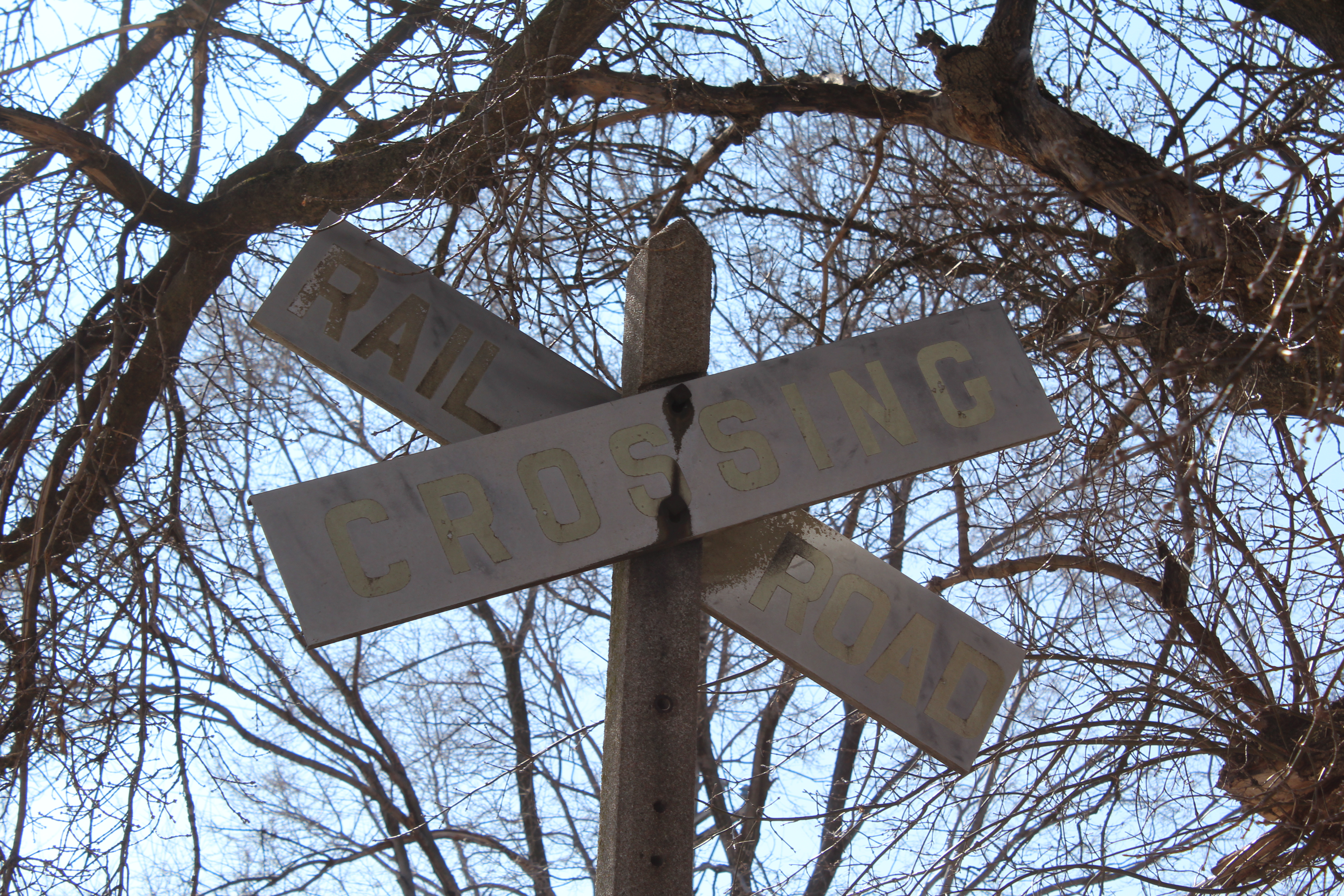
I followed some more old railroad right-of-ways, and some of the rails of closed lines are still on the ground, especially on LaRue Street, which leads from a former CB&Q line to the former Owens plant. The tracks are in the middle of the street. Some of the old “cross buck” crossing signs from more than 50 years ago are still standing. Between Owens and Thatcher glass companies, Streator was a glass town. It formerly was a large coal mining town, but glass took over in the 20th century. Thatcher closed in 1992 and Owens shuttered in 2024.

The Streatorland Historical Society was a must-visit for me. It is also a must-visit for ANYONE who has an interest in preserving local history. I was extremely impressed with its collection. Streatorland’s museum of local artifacts is abundant enough that 16 rooms contain its history. It. Kept. Everything.
Rooms at the museum are dedicated to, just to name a few subjects, glass, school history, local business, civic service, women’s dress, military, local sports, coal mining, railroads, and several other topics. What impressed me the most was the vast number of items – things as large as the stained glass transom window from the old Garfield School to an envelope from the local camera and film development shop. In some local history collections, minor things don’t share an equal spotlight. Some local history museums stop at a certain point (usually 75 years ago). Let’s take the local business room, for example. Something is going to trigger a memory. Does a Leslie’s Shoes logo trigger a memory? That was a store often found in malls from the 1970s to the 1990s. There’s one at this museum.
On the topic that artifacts from less than 75 years ago often do not have a space at a local history museum: it even has one of the uniforms from Streator High School’s 1983 Class AA state championship softball team. To put that into perspective, Sterling (my hometown) doesn’t have any artifacts from the 1977 girls basketball state championship team at its historical society – and that was the first one in IHSA history.
Something is going to trigger a memory. That’s worth repeating. The abundance of stuff isn’t meant to be a clutter, it’s meant to revisit memories of what life was like. Sometimes people need that. I’m happy to know that this can happen to middle-age residents of Streator. Bravo!
My next trip was to a place called Grant Street Grocery. I actually stumbled upon this on a Google Map pin, and was intrigued that the old neighborhood grocery store was still a thing in town. Sterling last had its in 1990. This store is a few blocks off of the beaten path near the intersection of two pure neighborhood streets. The store doesn’t have much for groceries anymore, but its business now hinges on deli sandwiches and burgers. I had a turkey and cheese sub for what I thought was cheaper than going to Subway. The largest burger there weighs 1-1/3rd pounds. Normally I am a big burger eater, but I’ve been trying to eat healthier lately. The interior also has an old sign from when it used to be Marx’s Grocery, and the old meat cutting table is now a small table that people can eat their sandwiches at.

I explored a little of downtown next. The Majestic Theater closed more than a decade ago, but its marquee is still there. There are several murals downtown as well. One of the largest displays of art is at Heritage Park – a greenspace where a downtown building used to be. Attached to the side of a building is a life-size painted wall of three downtown buildings, made to give the illusion that something is still at the sight. The three buildings depicted actually weren’t what was formerly on the site, but it is still a neat piece of art to look at.
Also at Heritage Park is a telescope, that, when looking inside, is a kaleidoscope. Why a telescope? It honors Streator’s Clyde Tombaugh, who discovered Pluto in 1930.

The last interesting thing I found in Streator was the Masonic Temple building. I found a unique peculiarity with the building’s cornerstone. Did you know that the Masons add 4,000 years to its naming of the current year for symbolic reasons? For example, this is 6026. The cornerstone has a date of 5905 (in Anno Lucis). That’s 1905 in Anno Domini. Why the extra 4,000 years? The Masons believe that the world was created 4,000 years before the birth of Christ. I didn’t know that until looking at the cornerstone.
I left Streator to go to my next stop: Pontiac. This will be my next entry. I’m sure I missed a lot when I went through town, but with any other trip, there’s always a second time to visit places I missed. So what did I miss? Let me know.
I came away from Streator with a deeper understanding on local history and preserving it. Sights from old cross buck rail crossing signs to that camera store envelope tell a story of a town’s past, and why it mattered. They rekindle lost stories that could one day be life lessons for future generations. While the town’s population has decreased since the heyday of coal and glass, I’m hopeful that future generations of Streatorites can take an appreciation of how the town shaped their elder’s lives, and thus theirs.
 Cody’s Road Trips