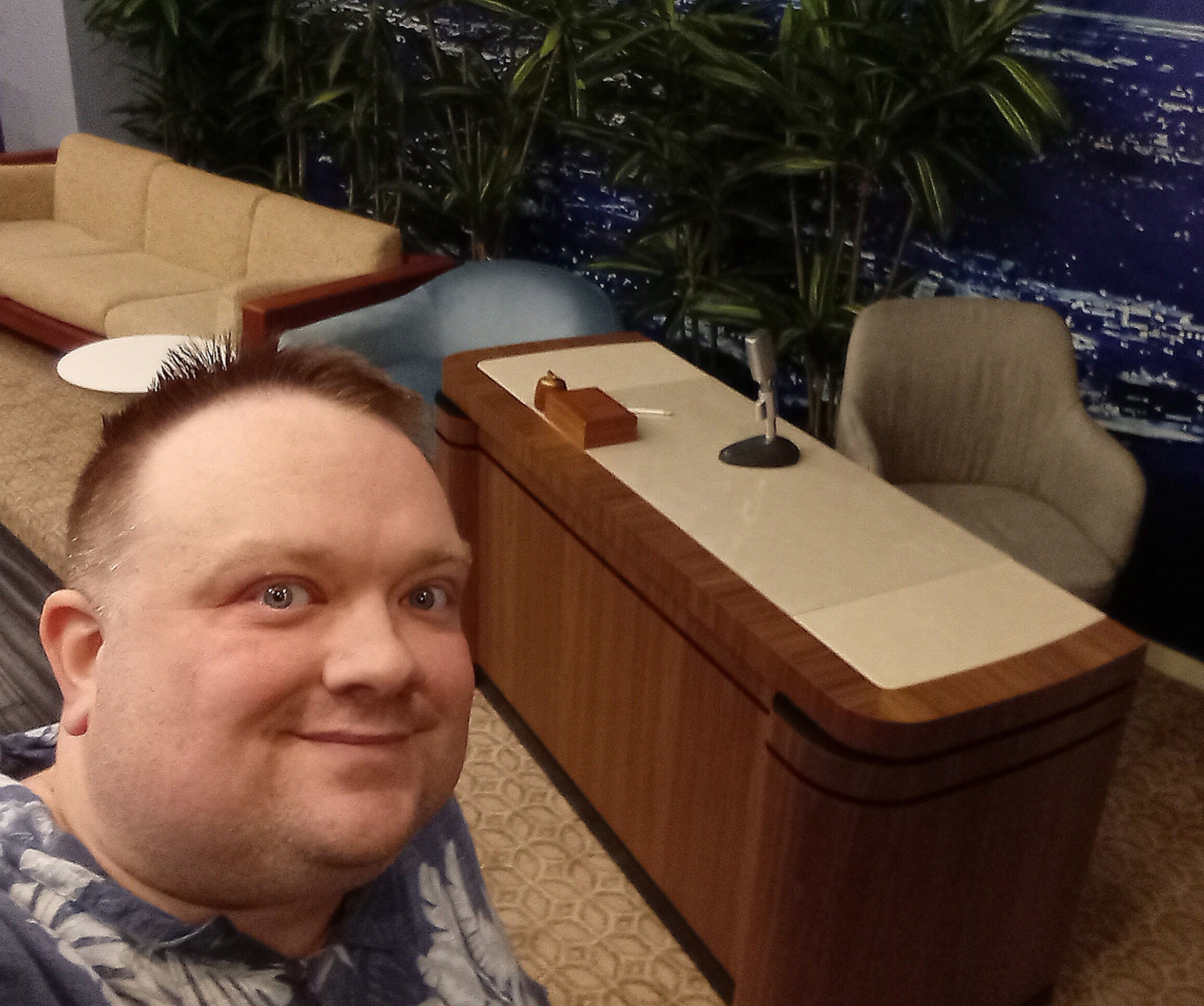
Television and radio are memories for most of today’s adults. Typically, museums don’t offer much on history of the most recent half-century or so of life. Then there’s the Museum of Broadcast Communications in Chicago’s West Loop, where memories of Johnny Carson, Bozo and Steve and Garry are being rekindled by those who come.
On this road trip (which wound up being a part-rail trip), I visited Hill’s Country Store in Kaneville, started on some Eddie Gaedel baseball player research in Elburn, and took Metra’s UPW “pink” line into Chicago from Elburn to visit the Museum of Broadcast Communications – and to continue work on fine-tuning my night shot photography. Posts on the others will come at a later date.
As someone with a college degree in mass communication, it only seemed fitting that visiting the Museum of Broadcast Communications in Chicago was on my bucket list. This small museum is on the ground floor of a building at 440 W. Randolph in the West Loop, and only a block from the Oglivie train station. The museum has rotating and permanent exhibits for radio and television. Oral history programs are on Thursday evenings.
It is important to understand that this museum is a temporary, pop-up arrangement. The actual museum, which had a public archive collection, had various locations in Chicago from 1987 to 2023 before it closed and eased into an online setup. This temporary setup opened in August 2025 and plans to remain into 2027. The public archive remains in storage.
***Click here to follow along in a new window with my Flickr photo album***
On this visit, the centerpiece exhibit was on the centennial of Johnny Carson’s birth, which was 1925. Information walls, artifacts from his television career – including a Tonight Show set – kicked off the tour, starting with a “by the numbers” wall of Carson and Tonight Show facts. Carson’s stint on the Tonight Show, from 1962-1992, is as American as apple pie. While Carson is best known as the Tonight Show host, his television and radio career had been ongoing for more than a decade, and this part of Carson’s life – the original CBS Johnny Carson Show and ABC’s Who Do You Trust – is well documented. Artifacts included a section of the blue audience seats from the Burbank studio, suits worn by Carson, Ed McMahon and Doc Severinsen – including Carson’s Aunt Blabby outfit.
Further down the walking path are brief histories of late night talk shows from 1949’s Faye Emerson’s show on CBS (she was married to future Carson Tonight Show band leader Skitch Henderson) to the current crew of Jimmy Fallon, Jimmy Kimmel, Stephen Colbert and Seth Meyers. The 75-plus-year history also includes Jay Leno, David Letterman, Conan O’Brien, Arsenio Hall and several others. One of Colbert’s desks is an artifact, as well as a Triumph The Insult Comic Dog puppet from Conan, and the saxophone Bill Clinton played during his Arsenio appearance.
Having read biographies on Carson and Leno years ago, some of the stuff there I already knew about, but those who never really got to know the people behind the desks, this is a great chance to go there soon and learn more. Did you also know that NBC promoted its TV lineup on bath towels in the late 1960s? There’s one there. Also, the men’s restroom has pictures of Carson, McMahon, Severinsen and Tommy Newsom above each of the four urinals. I think that was the only Newsom picture on display.
It’s been around 25 years since Bozo the Clown last had his show on WGN. Sadly, to my generation, the one younger than me – the kids today – doesn’t know who Bozo is. To kids around Chicago, it was a childhood dream to appear at a Bozo TV taping, and better yet, play in the Grand Prize Game by throwing ping pong balls into numbered buckets. I grew up when Joey D’Auria was Bozo, and remember the final years of Cookie the Clown. The “he/she did it!” and the fanfare that followed every successful bucket make are forever embedded in my mind. Artifacts include costumes, the “boy” and “girl” envelope drums, and a replica Grand Prize Game with ping pong balls for people to play the game.
The Radio Hall of Fame is also there, and it is an interactive video console display of inductee biographies. Several vintage radios are on a nearby wall, as well as some free trading cards of inductees. One of Chicago’s notable radio stations has its own exhibit there, 97.9 WLUP “The Loop,” once home to personalities such as Steve Dahl and Garry Meier, Jonathan Brandmeier, and others in the late 1970s through 1990s. Much of the display is history on a wall (including a whole wall on Disco Demolition), but there are some artifacts, such as token promotional items, a six-pack of Coho-Cola, and a Lorelei Shark color photo poster (“The Loop Girl”). Not many museums have nostalgia from less than 50 years ago – but here is one chance of several for those in and around Chicago to relive some memories. A shattered disco record from the event would have made the exhibit complete.
The walking tour concluded with a brief I Dream of Jeannie 60th anniversary exhibit with the show’s history, one of the genie lamps on the show, and a photo op with an inside-the-bottle pink backdrop. The museum also has a collection of old television sets, and a small Svengoolie exhibit with his original casket. There are a few more artifacts that I haven’t mentioned, but mentioning all of them wouldn’t make you come visit – so come visit!
The Museum of Broadcast Communications is a nonprofit institution dedicated to preserving and showcasing the history and cultural impact of radio, television and emerging media. Founded in 1982 by broadcaster Bruce DuMont, the museum collects, archives and presents content through exhibits, presentations, educational programs and digital resources that aim to educate and inform visitors – as well as promote media literacy. The media collections (as mentioned, in storage at this present moment) include thousands of hours of broadcast material, artifacts, and documents that illustrate the evolution of communication and storytelling. The museum emphasizes the role of media in shaping society, seeking to connect audiences with the past, present and future of broadcasting.
At $24 an adult ticket, I made sure I read through everything there and watched the videos as long as I could, including a video on Carson’s life that I didn’t get through before the museum closed. A small gift shop also is there. Here’s hoping the museum can find a permanent home and its artifacts continue to have some visibility – somewhere, somehow. We’ll have to see what the future holds for this place.
As mentioned, the museum is a block away from the Ogilvie Transportation Center, which serves Metra rail transportation from as far out as Kenosha, Harvard and Elburn. A trip just to visit this place, or walk around a little bit, can be as cheap as parking at Elburn for $1.50 a day, and a round train trip (between $7-$13.50 depending on the day and how tech savvy you are on phone apps). That will beat downtown parking fees any day.
 Cody’s Road Trips