Some cars are well known under the “classic” label – Mustangs, Bel-Airs, GTOs, and even the OG of classics with the Model Ts.
Other cars have their own special stories, and they reside in the minds of the beholders of those rides. The feature role may not be that of one of those classics, but no matter what shape, color, size or year, they each have a story.
You won’t find cars such as a Subaru Brat, a Toyota Tercel, a Plymouth Horizon, or a Nissan Pulsar among the likes of the common classics found at just about every museum that’s all about cards. They, too, have stories. Some have stories about design and aerodynamics. Some have stories of those machines being someone’s first car, or the car with certain backseat memories.
The Crazy 80s Car Museum in Dwight, Illinois honors these oddballs – odd in the fact that you’re not likely to see a collection of such vehicles under any other roof.
***Click HERE for the Cody’s Road Trips Flickr Photo Album from this trip to view more photos!***
The designs of many 1980s cars weren’t as slick as those in the decades both before and after. However, the machines from that decade help tell a story about the evolution of the auto industry, bridging from “boats” to modern times. This was the Malaise Era – named for the negative connotation and a struggle to deal with oil crises of the 1970s. Boxy builds and increasing U.S. government regulations resulted in unique designs and advancements that have mixed reviews among anyone who ever drove them. The smaller, the better was the mantra of the time.
While the vehicles of the 1980s may not have had the visual appeal, the evolution did lead to making them much better in the 1990s, and that evolution continues into today’s rides that are starting to become living room-like.
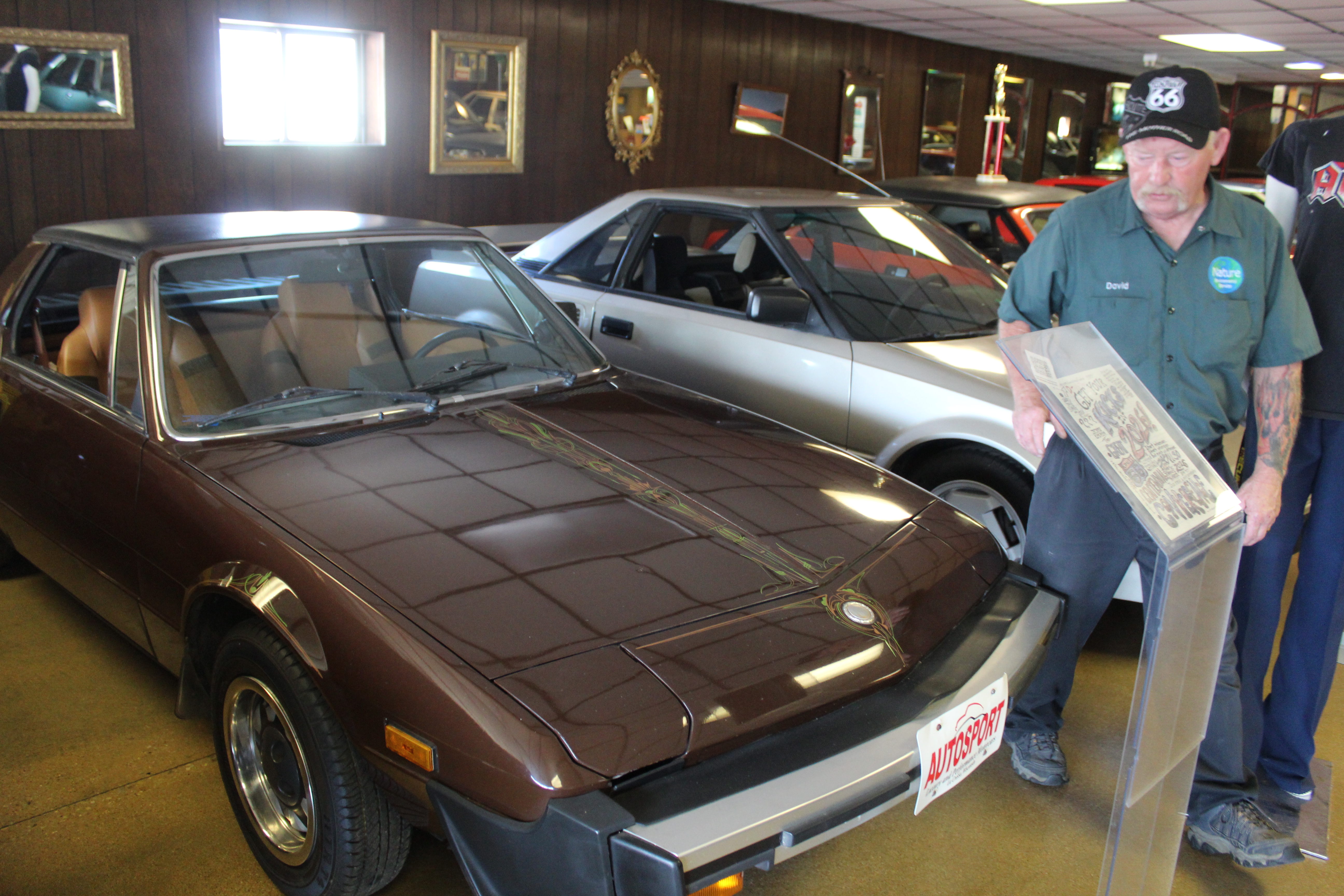
The museum opened just a few years ago inside a former furniture store on the northwest part of this small town, showcasing a collection that took years to build. There’s a ringer at the front door, and that cues owner Rick to greet visitors and introduce the museum. Visitors are greeted by two paralleling rows of cars for one-half of the museum’s main room. Some cars have the original owner’s manuals on them, as well as sales flyers. Historical information is posted on signs along the center walkway, including that of describing the Malaise Era and the oil crises. Dotting the open spaces along the way are 1980s mementoes, such as a kids pedal Oscar Mayer weinermobile. Most cars have a window down to show their interior, a hood up to show what’s underneath, and some have a door open (do the right thing and don’t climb inside them).

Further adding to the museum’s visual aura are the decor on the walls, such as motion waterfall pictures, and the building’s original 1970s-style wood wall paneling. You get a feel that you’re in an 80s garage, too, with a collection of colorful automotive accessories, cans and advertising from the time. The middle of the museum’s primary room has a collection of kids toys and other items that snap one’s memories back to the time period. That’s what this place truly does: It’s a time warp back to younger days, and more formative days. The largest non-vehicle artifact on display is a 1960s McDonald’s electronic merry-go-round, back in the day when Mayor McCheese as just as known among the colorful creatures as the Hamburgular and Grimace. The machine still operates and plays the original music once Rick turns it on.
The 1980s also was when Japanese automobiles exploded onto the American market. Nissan, Toyota, Subaru, Hyundai, Mazda and others gave buyers much more of a variety to choose from. The different styles led to may more unique vehicles being on any road at any given time – for example: Consider a stretch of the Kennedy Expressway in Chicago before the 1970s, you are likely to find multiples of the same car on it passing by within a 10-minute span. There were more vehicles to see come the 1980s. Among the Japanese imports is one called Datsun, which later became Nissan. One of the Datsuns on display shows this evolution: an original sales display from the Highland Park, Ill. dealership shows the Datsun name on a logo that many people 40-and-younger recognize as the Nissan logo. European imports also are on display, including “Le Car,” from Renault in France.
Gazing at these vehicles is sure to trigger random 80s thoughts: Knight Rider, Van Halen, the Super Bowl Shuffle, The Breakfast Club or Hulkamania, just to name a few. There’s nothing “Malaise” about that. Is the bass from “Take My Breath Away” playing in your head?
I, too, am a product of the 1980s. My family’s first 1980s car was a red 1988 four-door Ford Taurus. There wasn’t one at this museum, but there are several other red cars there, as well as burgundy – a color apparently popular then. I was never a car kid growing up, and there are many things about cars that I still don’t know. The shapes of these cars were peculiar to me, though. So was the company logo art, which I first discovered while browsing the yellow pages at age 4. When I was in grade school, I sometimes would sit and look outside the window out at one of the semi-main roads our house was on, and take note of the kinds of cars that drove by. I used to even keep tallies of which cars drove by on a piece of paper; like, how many Chevys drove by, or wondering if I was going to find a Mazda. This wound up being one of those memory recall exercises that I created on my own, remembering the car’s make and model from being up close to them, and trying to ID them from looking out the window.

There are cars that your parents, grandparents and great-grandparents drove. There are cars that your neighbor or teacher drove. A grade school teacher’s aide of mine drove a really ugly Toyota van. An even earlier version of it, from 1985, is at this museum.
The showcasing of automotive history balances with the showcasing of life of the 1980s that people 50 or older can still recall with a smile on their face.
The irony of the museum’s location is that it is in a town on U.S. Route 66. The famous highway, celebrating 100 years this year, was decommissioned in the 1970s before any of these museum cars ever made it to the road. While not necessarily relatable Route 66 nostalgia because of the time period, this place is still a must-stop along the way. It’s okay to balance the 1980s memories with the 1950s ones. It gets the typical share of 66 enthusiasts; and a German group happened to stop by when I was touring. The museum is actually on an original loop-around alignment in town, and a few blocks from where the former Pontiac Trail breaks off from 66. If it’s the earlier classics you’re looking for, Pontiacs in particular, Pontiac, Illinois is about 20 miles south along 66, and is home to the Pontiac-Oakland Auto Museum (a future post on here at a later date).

You’ll probably wonder, does Rick drive an 80s vehicle? Yep. That’s his late 80s white Chevy S-10 out front. He had to mow the lawn out front by the time I was leaving, and we chatted for a little before I left. My 2017 Nissan isn’t an 80s car. We talked about how the new cars have computers that keep track of small details, and how he, of course, felt comfortable about operating his simple truck.
Another conversation piece Rick and I talked about was the fact that, on the way to Dwight, I had to take a couple of detours on gravel roads. The dust collected on the surface on my car, and he told me about the car wash in town that I could stop at. Rick also made sure to mention to me that small town car washes, he said, were much better than those in larger cities. He said that homeless people sometimes camp in the larger car washes, and you’ll find none of that in small town Dwight. Draw your own conclusion.
Crazy 80’s Car Museum
316 W. Waupansie, Dwight IL
815-405-1232
Open: 10 a.m. to 2 p.m. Tuesday, Thursday and Saturday
Find it online on Facebook


Really enjoyed the pictures!
LikeLike
Thank you!
LikeLike