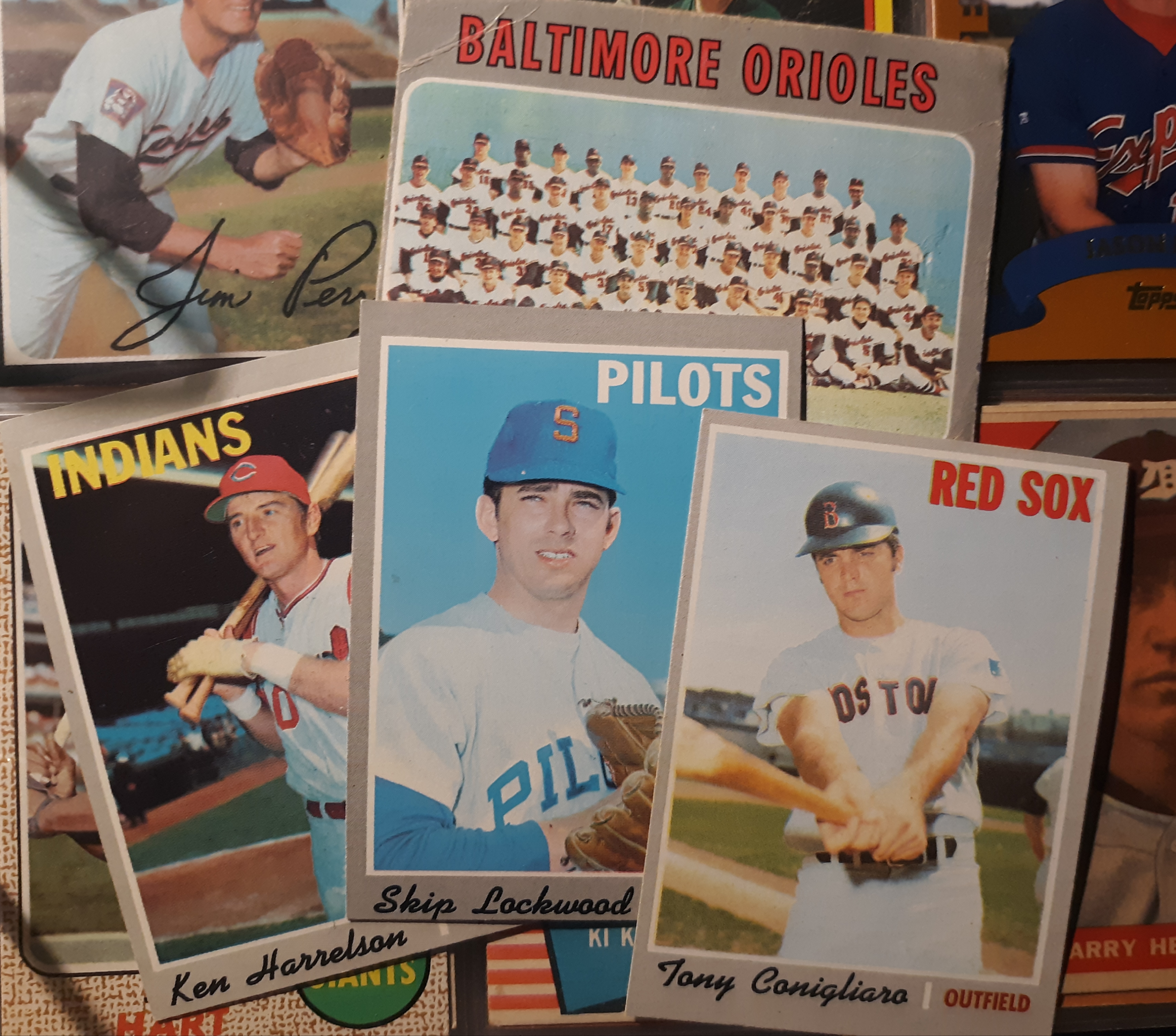
Baseball cards were an interest since I was 4 – way back in 1990. The first card I remember seeing was a 1986 Topps card of Jose Rijo. They were just like toys, and I didn’t take care of them. They’d wind up in the toybox. Then one day not long after we had just moved from Sterling to Rock Falls, I gathered all of the cards and put them in a pile. There were probably around 100. The interest in baseball cards grew greater at age 7 when I found out my soon-to-be grade school best friend, Jared, also collected cards.
One day when out family was shopping at Big Lots in Sterling, I saw this box of 792 baseball cards. Way more than I already had. I wanted it. It was arranged to be a present from my grandparents. Before Christmas, me and my brothers and cousin made colorful handprint wrapping paper with paint and brown paper. On Christmas, I saw my present in this wrapping paper. The size and shape of the present looked familiar to me. I was prematurely excited that I “got” the cards before we unwrapped our gifts.
Obviously this more than doubled my card collection. They became Christmas and birthday presents. They became rewards for doing a good job helping around the house. Then I discovered the 1st and 10 sports store in downtown Rock Falls. I started collecting cards in more sports – football, baseball and racing in particular. The interest in other sports didn’t last long.
As a boy with Aspergers Syndrome – something I would only know retroactively, many years later – I devised a unique way to sort my cards in this large former toolbox that my dad gave me. They would be sorted by teams, the oldest cards first, alphabetized by brand name, classified further by the card value (for example, the commons of 1991 Fleer came before the minor stars, followed by the semi-stars and the unlisted stars, according to Beckett). The newest cards would be at the bottom of the stack. One day, when my friend Aaron went through the cards, he got many of them out of order – and it made me really, really mad. That’s Asperger’s for you.
I moved from Rock Falls to Sterling when I was 11, and it’s where I still live (2026). I found another sports card shop in downtown Sterling, Home Plate, and it further expanded my interest in baseball cards. I became old enough to ride my bike to the sports card shows at the local mall, and I was introduced to many, many more cards. At this point in my collecting interest, I found a tremendous amount of pleasure in finding a $1 card for $0.10. It felt like I was making money.
I had accumulated plenty of cards for my collection by this point. Some of which bought with money my parents gave me. I had no way of making money as a 13-year-old, other than maybe helping out on my brother’s paper route, or keeping the change from a store run for my mom. Eventually at some point, I had to learn the art of selling things. The cards, obviously, were the perfect tool. Someone (probably my Dad) suggested to me that I take some of the cards that I don’t really “need,” put them in a binder, and show them to the dealers at the next card show and ask if they would like to buy any.
That seemed like an awesome idea. At the time, hardly any of my friends were into baseball cards the same way I was, so my best shot to sell them was at the show. Knowing that the big star cards were going to garner the most money, I took whatever mint-condition star cards that I wanted to part with, put them in separate album pages and into a binder to carry with me at the show.
My “big star cards” were what I would call your general, run-of-the-mill base cards from basic sets like Topps, Pinnacle and Upper Deck. Nowadays it’s more of a no-thrills selection, but a 1990 Leaf Roger Clemens base card was quite the thrill for this 13-year-old. 1990 Leaf was a popular set, and I figured I could get something out of it.
I assembled my cards, looked at the price guide, put price stickers on each album page slot, and carried it to the show with me. The first go-around resulted in nothing. I did receive a good tip, though, that I had better chances of selling the cards if I asked for half-price from the book value. That was a little tough for me to swallow, but if that meant clearing the whole binder, I still would have made out with some good money to save for a “big ticket” purchase such as a new baseball glove.
Taking that early advice, I marked my cards down, took some out, put some new ones in, and tried again at the next show a few months later.
Many tables had single cards under glass cases, single cards laid out along the table, cards in boxes, boxes of packs along the tables, and each single card looked like it was priced right at book value.
I had a success! It wasn’t quite all that successful, but it felt great to actually sell cards and get … drum roll … $1 out of it. The money didn’t add up in my favor, but just to get the very first deal accomplished was worth whatever loss I was taking.
Excited after my first sale, I had several others take no interest, and that was fine – I still had a memory. It was all going great until I visited one table near the mall’s front entrance.
He had some singles on his table, priced at book value (which I memorized from constant reading of Beckett’s monthly price guides). Showed him the binder. He saw the 1990 Leaf Clemens. He must have known it was a premium set, and probably didn’t think I quite knew that. He asked me how much I wanted for the Clemens.
I looked at the sticker. “$1.50,” I said.
After some visual scoffing, his voice grew louder to where probably half of the mall heard it.
“I’M NOT PAYING NO F****** DOLLAR FIFTY FOR A ROGER CLEMENS!!!!”
I was embarrassed. I was scared. This guy had mentally ripped my collection to shreds. I took back the binder and wanted to run away, sit down and pout. Unfortunately, the nearest benches were in visual distance from the guy’s table, and the next bench was clear on the other end of the mall. I was beside myself. I thought if this guy was going to say something like that, he wouldn’t be the only one. The 13-year-old in me thought that all dealers thought alike.
I didn’t know what to think. I tried to think. I knew that my cards weren’t all that flashy. As I was finding my way back to some tables, having regained some of my composure, I started looking at all of these singles, all priced at book value.
Then it hit me: What gave someone else the right to sell a card for book value, and I couldn’t do it for maybe 1/4 of it? What gave them the right to make more money off of a card than me, the person who originally had the card in the first place? Why was I to only sell my cards for coins when they were going to turn around and sell it for a couple of bucks? That felt like I was being used. The 13-year-old kid in me couldn’t grasp why this was happening. Why was I to make less money than them?
Among my cards: Certainly not a piece of Ken Griffey’s game jersey or a slice of Babe Ruth’s bat. I thought I had a good collection of baseball cards. At least that was what I was told – by friends and loved ones. As it turned out, I got lost in changing hobby world where people now were ripping open boxes to find these cuts and pieces of history, as they were new at the time. With what money I had, I couldn’t afford to buy Upper Deck, let alone any top-tier pack. Topps, Donruss, Pinnacle, Score and Collector’s Choice were my go-tos, because they were cheap.
As newer, flashier cards became the rage (often featured in the monthly Becketts), and pack prices increased by a lot, it made my existing collection seem disappointing. I originally felt proud to gather the collection that I had, but if I was going to be treated like that, with cards that were memories of yesterday, I didn’t know what to do. I certainly didn’t have the money to be tearing open any packs of the flashier cards.
Did I have to be an adult in order to make the full price out of a card? This whole thing baffled the bejesus out of me. I was confused. I didn’t know what to do. My cards were in mint, I knew how that process all worked. That was really the downfall to my childhood card collecting awesomeness. When you weren’t allowed to make as much money as the adults were.
When I realized that those cards I had weren’t going anywhere in value – the very first time I heard the phrase “junk wax” before – I slowly started becoming fascinated with vintage. Home Plate had a $1 box of vintage cards, and the first two vintage cards I remember buying were from 1971 Topps, a Senators team card (because who else my age had a SENATORS card!) and the Senators’ Frank Howard (after looking at the back of the card to see that he hit a lot of home runs, “He must be good,” I thought). The 1971 Frank Howard is one of my favorite cards, and kicked off a love for vintage collecting.
This renewed interest didn’t last long. I grew up. High school sports and journalism became my new interest. The baseball card interest faded. I’ve been in high school sports journalism for 25 years as of 2026 – and I’ve written about non-sports things since 2018.
I finally moved out of my parent’s house a few years after graduating high school. Those baseball cards that I hadn’t touched in quite some time needed to be moved, but I had chose to leave them behind. Then social media became the rage. By this time, the hobby had evolved into having everything in “slabs” (professionally graded cards by companies with alphabet soup acronyms) and “Any PSA 10s” became a common question that I didn’t have an answer for. A few deep dives into the social media aspect made me want to haul all of my 50,000 baseball cards from my parents’ to my place.
Still, in the late 2010s, I knew that my cards weren’t going anywhere, especially in value. I embarked on another one of those “Aspergers”-like sorting projects: Keep one card of stars on each team they played for, and eventually find a way to part with the excess. Exploring these cards again renewed my interest, and I began to take more deep dives into the cards as Covid hit.
Covid, of course, ignited a nationwide interest in card collecting – and re-interests, too. I started going to card shows again. I started going on dedicated baseball card road trips.
However, I never did catch on to a big reason why the hobby spiked during this time. That reason: money. I wasn’t interested in flipping cards to make money. My interest was education and interesting fact sharing about baseball cards. You will only find a grand total of ONE “slabbed” card in my collection: It’s a 1998 Collector’s Choice The Big Show (World Headquarters Edition) card of Cal Ripken. It was a free offer with a Beckett price guide subscription I had at the time. Don’t get me started on what PSA charges to grade cards today.
With the hobby focusing on 20th century cards and players, I became lost in an era where cards had a thousand variations, even more game-used stuff and autographs, serial numbered cards to reflect scarcity, etc. The prices of boxes of cards were outrageous, and so were the packs. I didn’t believe that was an investment that I wanted to make in my life; I had other much more important things my money was to go for. That wasn’t my biggest surprise – It was the fact that people now were starting to fight over them in the store like it was Black Friday.
Hundreds of dollars. Thousands of dollars. Buying and selling online as if it were the New York Stock Exchange. Expensive and overwhelming for me. Wasn’t what I wanted to do. Hell, I don’t even know how to sell on eBay. Hell, I don’t even know how to play fantasy sports. I’d lose track of time and get more mentally lost than what I already am.
Still, I had these cards that have been in the binders since my teenage years. Sure, a few more have joined them. But could I EVER sell those cards in today’s shows? Not if people are going to constantly plop down Ben Franklins for a bunch of Shohei Ohtani’s; I only had George Washingtons to give for the cards I wanted. Because of that, it’s like the bartender effect: The dealers are going to give all of their attention to the people who give they more money than the ones (like me) who don’t have much to spend.
I eventually became comfortable sharing my own hobby story on the internets. You’re reading it now.
The current chapter of my hobby history is collecting with quality instead of quantity. I collect cards that I can turn into 5-minute conversation pieces. I have six binders worth now. As for the remaining rump of my cards, I’m creating $10 banker boxes and reinvesting that money back into finding these unique cards. What cards are these, exactly? The point of this baseball card portion of this website will attempt to share that in several ways in the future.
I’ll share some of the cards I have from 1995 Topps Cyberstats – the parallel that tried to adjust stats as if the 1994 strike didn’t happen.
I’ll share the irony of Bernard Gilkey’s 1996 Metal Universe card – and why the alien spaceship on it is particularly unique.
Those are some of the tales I hope to share through this.
Sometimes I ask myself, “Do I want to try one more time to sell some cards in binders to bring?”
Along the way, I’ve made “accident” purchases of cards that I already had. One of note is a 1968 Topps Elston Howard. I would take the better conditioned one, and assume that it is a 2 (fair) even though it’s probably a 3 or 4. 1950s and 1960s “poor” goes for 10% of book value, and 1970s and 1980s “poor” goes for 5%. At $6, the Elston Howard is probably $1 tops. I’m okay with that. Don’t know if any dealer is.
With money being made and transactioned around constantly, it gives me the impression that dealers are clamoring for money using every possible convincing sale trick in the book. Siphoning collectors like myself.
I felt irked at one recent card show simply because I wore a Blackhawks cap. I didn’t even see this dealer’s stuff on the table over from the one I was looking at until he said, “I got your Blackhawks, right here …” and then showing me a bunch of autographed pictures and telling me a price. Dude! Slow your horses! Just because you see me with a Blackhawks hat doesn’t mean I’m going to buy Blackhawks stuff! Chill! I know you want money, but come on, man! It’s probably great salesmanship, but it kind of creeped me out a little.
If I have anything to sell, it’s like I’m flipping pennies, or playing poker with quarters and dimes and nickels. Maybe I can flip that 1965 Topps Bill Mazeroski – the Pirates Hall of Famer with the famous 1960 home run – that I bought for $1, into $2.
But who’s going to remember who Bill Mazeroski is?
Maybe a kid doesn’t have a single Cal Ripken in his collection. I have a 1984 Fleer for sale, books for $10, I don’t even know what to sell it for. I don’t want to give the impression that I’m “ripping off” a kid, too.
A friend of mine does deals a lot, and absolutely insists that the buyer starts with naming the price. I can’t do that. I have flashbacks of that “f****** dollar fifty for a Roger Clemens” with even more of a fear since money means a lot more in the hobby than it did when I was 13.
It can be lonely being a coins guy in a dollars hobby. I’m coming to terms with today’s hobby, but still aim to remind collectors of what makes a 1988 Topps Big card of Ken Griffey Sr. special. That’s another story for another time.
Update: So what am I doing as of 2026?
• I am collecting baseball cards of players who have ties to Sterling and Rock Falls (my hometowns). These PCs (personal collections) include:
Jakob Junis (a current MLB player, RFHS grad)
Noah Junis (current MiLB coach – and Jakob’s brother – RFHS grad)
Brendan Tunink (a current MiLB player, Newman Central Catholic grad)
Seth Blair (MiLB player, RFHS grad)
Mike Foltynewicz (former MLB all-star, born in Sterling)
Dan Kolb (former MLB all-star, former RFHS student) –– possible update on my Dan Kolb PC coming soon!
Gary Kolb (pinch-ran for Stan Musial on his final at-bat, RFHS grad)
Ed Acosta (MiLB player, RFHS grad)
Kurt Bogott (MiLB player, Newman grad)
Van Sowards (MiLB player, Newman grad)
Dan Matznick (MiLB player, SHS grad)
Steve Eddy (1979 Angels, born in Sterling)
Nick Pepper (semi-pro player, SHS grad)
This list is not final, as there may be athletes (regardless of sport) from the surrounding area who I have written about for high school sports journalism in the past. There are other players aside from those mentioned who have smaller connections to my hometowns, but they’re too much to explain at the moment.
• The List, obviously. I have eBay set up to send me alerts on those cards and I’ll act if I consider the price to be right for me.
• I have stopped buying packs and blaster boxes of new cards with the 2026 Topps base set. I have at least one card for each year Topps has been a major player in the market (since 1951), and I’ll end at that. Opening them no longer intrigues me.
• No matter what, the itch to think about baseball cards happens from time to time – and I’ll step into a time-consuming rabbit hole to escape from the rigors of life. I’ll also feel an itch to dive into boxes when life gets real tight. I do not expect to find my List cards in such boxes, but I simply collect what visually appeals to me. There’s no rhyme or reason behind what I look for – a car simply has to stand out to me in the moment, and then I ponder whether I really want it or not. These cards get tossed into a “recently bought” box for me to sort them into my albums one day. In short, digging through boxes of cards can be therapeutic for me.
• My existing album set includes “every team a star player played for” cards, special cards to me, unique and unusual cards, those “book priced” at $1 or more that I consider worth keeping, and my very best ones. There are 7 binders total. I also have my restored 1992 Donruss set and remaining 1987 Topps “Uncle Scott” cards; as well as those cards remaining from my earliest childhood. I have a binder of a complete set of 1986 Fleer (birth year). There is also a small set of game-used/patch cards that I received in the mail as a kid (which is a “sob” story I will mention sometime later). I also have two boxes of commons/stars from late 1970s Topps sets that are being kept for possible sale down the road, but I’m hoping the prices rise.
• There are about 30,000 “excess” cards that I am attempting to part with, but I need to shuffle from the Aspergers-like sorting system I put in place as a child in order to make a 5,000-card bankers box of them appear random. This is an ongoing project. I have sold two bankers boxes already, and there are six more planned at $10 a box. These cards are from 1980-present (many junk wax), of all sorts of ranges of player talent (HOF to common) and in many various conditions (8 to 1). When I complete the next bankers box of 5K, I’ll post it for sale on my Facebook. I also have a small box of non-baseball that I’m not sure what to do with at this time. The large case that those 30K cards are in would be eventually sold, too.
I have contemplated “retirement” or “semi-retirement” from the hobby, but it’s been a part of my life for so long that it really can’t leave me. My hobby approach simply evolves, like it did from quantity to quality.
I had given thought to making a whole website about the interesting information about the baseball cards I have. Written lists and stories, video clips, pictures, etc. I even thought about making this “baseball card” part of the website just as active as the road trips. However, there simply is not enough time in my life to make it all happen right now.
I’m hoping that I can put my binders, and other small boxes as mentioned, into storage bins and haul it to the attic, and part with those 30K “excess” cards. Once that’s done, all I’ll have left within my grasp is a “to be filed” box with whatever new cards appeals to me. Then maybe one day when I real bored, like retirement or something, I’ll spend time with them again.
[Portions of this writing came from an old blog post from 2022.]

