As the United States of America is set to celebrate the 250th anniversary of its establishment, the story of how the country took its shape comes to mind.
Illinois – at least the land that would eventually become the nation’s 18th state – had a significant role to play in the country’s growth. While school history lessons are largely contained to the story of the 13 colonies, some mention of George Rogers Clark’s expedition to take Kaskaskia, a fort along the Mississippi River, from the British simply acts as a footnote. While the colonies fought for independence, they also sought to include the western lands – those west of the Appalachian Mountains – they claimed. Those lands reached all the way to the Mississippi, despite having originally been settled by Native Americans. Present-day Illinois was known as the Illinois Country, overseen by Virginia.
The Mississippi River was mapped and promoted in high importance starting with the expedition of Frenchmen Jacques Marquette and Louis Jolliet in 1673. France lost its claim to lands east of the Mississippi during the French and Indian War nearly 90 years later. Controlling the Mississippi would give the new American country some breathing room to grow on.
In the effort to control territory east of the Mississippi, the Colonial soldiers had to rid of British threats along the river; this included British-aligned tribes such as the Sauk. In 1778, Col. George Rogers Clark brought Colonial troops along the Ohio River to reach the Mississippi. With the help from Frenchmen who stayed after the British occupation, Clark’s troops found it really easy to control the Ohio and its tributaries – including Vincennes along the Wabash River – and make the way up the Mississippi.
Fort Kaskaskia was taken without bloodshed, and Clark’s men easily captured fort administrator Rocheblave – a Frenchman appointed to oversee the fort after its capture a decade previous. Helping Clark and his men in the peaceful overtaking of Kaskaskia was Fr. Pierre Gibault, who was Vicar General of the Archbishop of Quebec for the Illinois country until British takeover. Gibault continued to preach at the Church of the Immaculate Conception in Kaskaskia as part of his circuit of churches, which went as far as Vincennes.
Nearby Cahokia, home to ancient burial mounds, also was taken by the Colonists. In 1780, not long after a British-Native attempt to recapture Cahokia, Clark ordered retaliation on the Natives. A force led by Col. John Montgomery sailed up the Mississippi and burned Saukenauk – present-day Rock Island. A young Black Hawk would have been a teenager at that time – and who knows, that could have given him some thoughts for his own War nearly 50 years later. One won’t find the Saukenauk skirmish in the school history books – unless you’re close to the Quad Cities, perhaps.
The 1783 Treaty of Paris solidified American control over the land east of the Mississippi. In 1787, the Illinois Country combined with a couple of other territories to form the Northwest Territory. Present-day Illinois became part of the Indiana Territory in 1803 after Ohio reached statehood, and Illinois Territory in 1809 – nine years before statehood. The same year Ohio reached statehood was when the United States purchased the large swath of land from France that would become the Louisiana Purchase. Louisiana became the first state with land west of the Mississippi River in 1812, followed by Missouri in 1820.
Kaskaskia and Rock Island have tributes to their Revolutionary War connections with visitable sites today.
I visited Kaskaskia in 2018 (Facebook photo album link) as part of a road trip up and down the Mississippi River from the Quad Cities to Cairo. Kaskaskia is unique among territory of Illinois in that it’s actually WEST of the Mississippi, and only accessible by crossing a mid-sized stream from the small Missouri town of St. Mary (along U.S. 61). This is because a major flood in 1881 changed the Mississippi’s course. That mid-sized stream was where the river was before 1881, but only after the most recent ice age*.
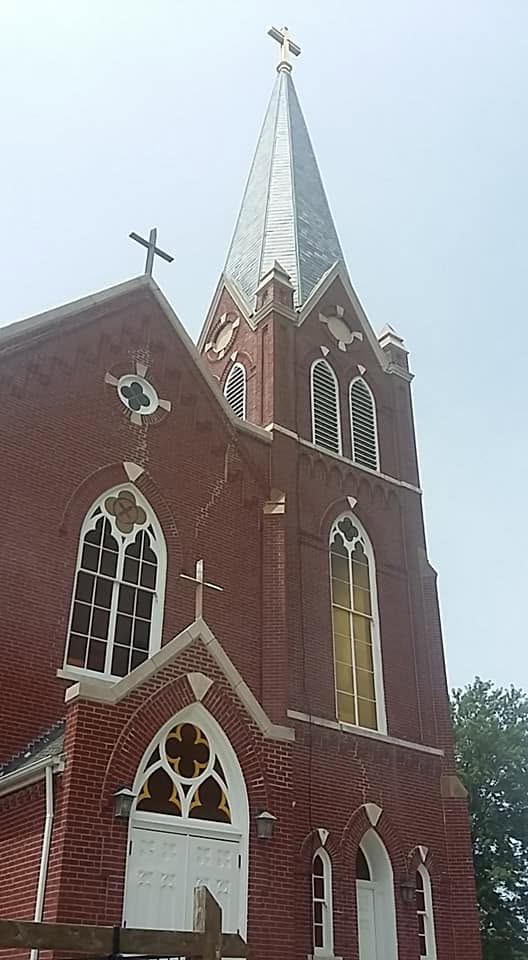
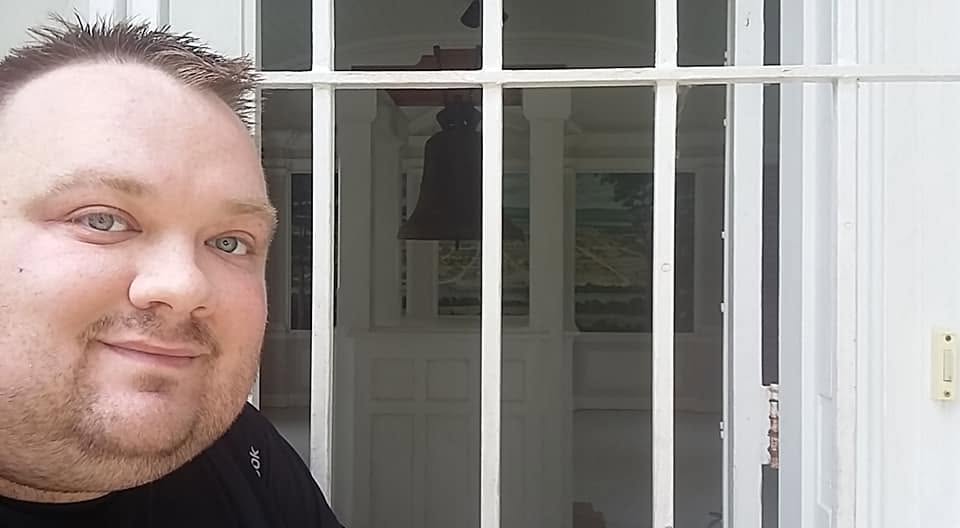
The island where Kaskaskia is sparsely populated. Because of flat land, floods had a lot to do with that, especially the big one in 1993. Only a handful of people live in the town proper, which has a few streets in a grid. The aforementioned Church of the Immaculate Conception continues to be an active church overseen by the Belleville Diocese, with mass at 3:30 p.m. on Saturday. A smaller building, the Kaskaskia Bell Memorial, serves as a museum to Kaskaskia’s history. The bell was a gift by French King Louis XV in 1741 to the Catholic Churches of the area. It is only open on July 4 for entry, but the bell itself can be viewed any other day of the year through the front door; when closed, push a green button to have the door automatically open for a short period of time before it closes again. (This is the picture at the top of this page).
The Bell building is overseen by the Fort Kaskaskia State Park staff. The actual fort ruins are on the Illinois side at a park about 5 miles north of Chester (where there is a new bridge over the Mississippi being built at the moment). The fort is atop a bluff looking down toward the west.
In Rock Island, the Saukenauk site along the Rock River – and a mile east of that river’s mouth to the Mississippi – is known to be the westernmost Revolutionary War site – about 20 miles due west of Kaskaskia but about 150 miles north. This Native village was known to the one of the largest in the current boundaries of the lower 48 states at one time. It is remembered today not for the Revolution connection, but for Black Hawk’s desires to prevent his home land from becoming part of the United States – an attempt that ultimately failed in 1832. Efforts to preserve the Saukenauk village resulted in the creation of the Black Hawk State Historic Site (where I visited and wrote about in 2025 – click the link to the left to read that post and to learn more about the site).

A historic marker noting the Revolutionary War connection was originally placed at 12th Street in Rock Island near where it merges with 11th Street (U.S. 67) just before it crosses the Rock River. It has since been moved to the Black Hawk State Historic Site.
Illinois’ connection to the American Revolution set up a historical chain of “begats” – if the Revolution was contained to just the colonies themselves, it would have taken a while to expand westward. Then does the Louisiana Purchase happen? Then does Lewis and Clark take off from St. Louis to reach the Pacific Ocean? Even though the British didn’t invest too much in the protection of the Mississippi River – evident by easy takeovers by Clark and the Colonials – the river’s securement played a huge role in the concept of Manifest Destiny of the United States.
Explore more …
Black Hawk State Historic Site
1510 46th Ave., Rock Island, IL
Lodge and museum is open from 9 a.m. to 4 p.m. Wednesday through Sunday, with an hourlong lunch break at noon (hours may differ off-season and on holidays)
309-788-0177 (park office), 309-788-9536 (museum), 309-230-8885 (event rental)
Web: Blackhawkpark.org
Kaskaskia Bell Memorial
First St., Kaskaskia, IL
Indoor bell open for public viewing through gate year-round, special events held on occasion, including July 4.
618-859-3741 (more information)
Web: dnrhistoric.illinois.gov/experience/sites/site.kaskaskia-bell-memorial
*Footnote – The Mississippi River’s original course wasn’t always its present shape. Until the Pleistocene glaciations (80,000 to 20,000 years ago), the river’s old course originally went from Albany in Whiteside County to Hennepin in Putnam County, where it flowed along the north-south leg of the Illinois River to near Alton. The Albany-to-Hennepin path has since been glaciated over, but hilly and surface elements exist to show some proof of the old river bed.
**A note about this website’s activity – I haven’t been updating this website a whole lot lately due to commitments with my journalism job. This summer has been a challenging one for my work commitments. It hopes to ease down in mid-July.

