Wrestling has been part of my life for a while, even if my own connection to the sport has mostly come from watching rather than competing – and covering high school wrestling off and on over a 25-year journalism career.
Two of my brothers, Mike and Chris, wrestled at Sterling High School and Challand Middle School. Chris was a captain for the Golden Warriors during his senior year, and is currently an IHSA official throughout northwest Illinois. The professional version of wrestling – WCW and WWF(E) – was something we watched growing up.
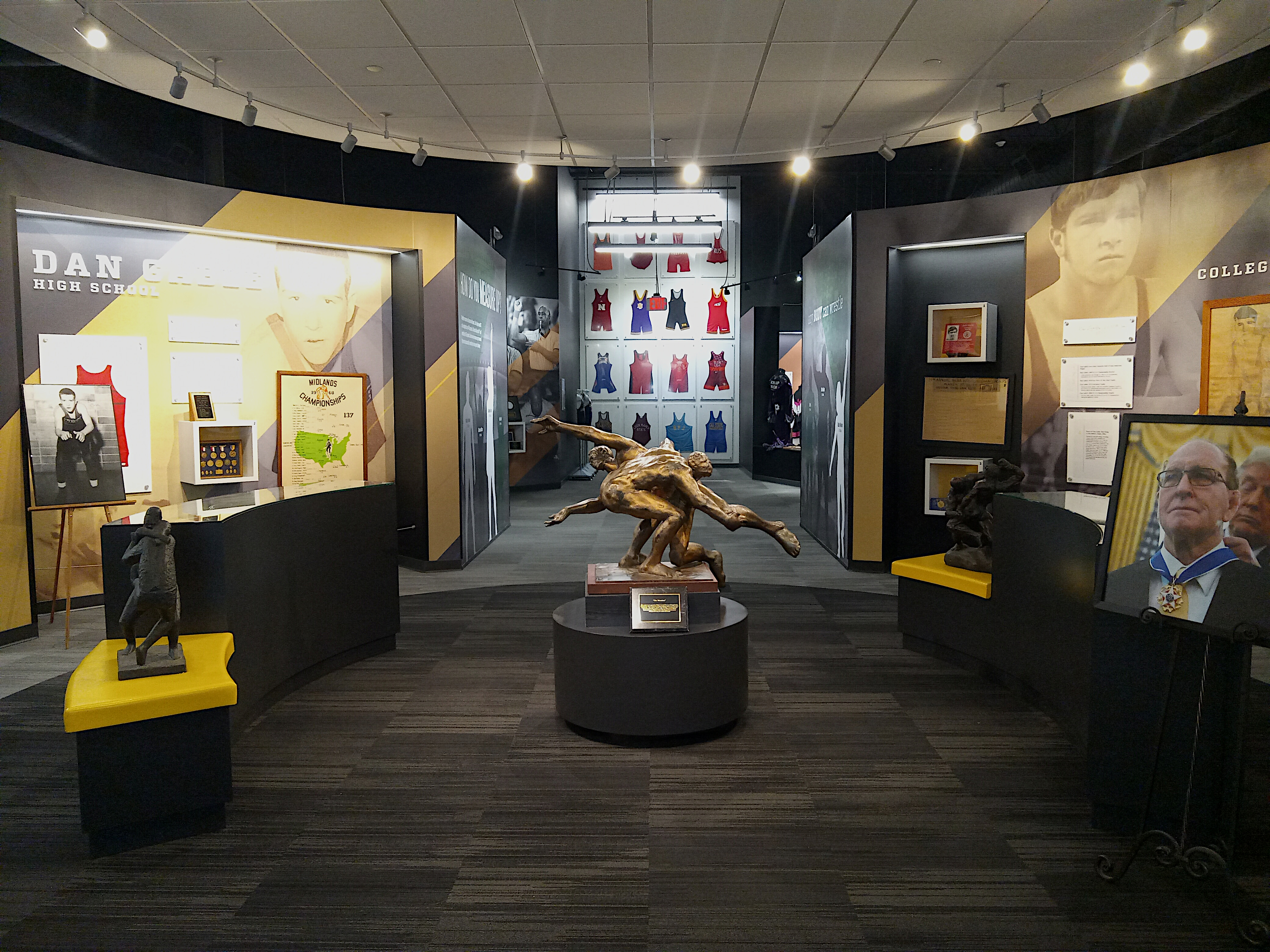
A visit to the National Wrestling Hall of Fame Dan Gable Museum in downtown Waterloo, Iowa, offered a chance to revisit both sides of that world under one roof.
***Click HERE to view my Flickr photo album from this visit***
Beyond its professional wrestling collection, the museum celebrates the athletes, coaches and milestones that shaped amateur wrestling, particularly in Iowa.
Wrestling is Iowa’s sport.
Gable memorabilia includes the warm-up clothing and shoes he wore during his Olympic triumph, along with artifacts from his college and coaching years. The museum also highlights Iowa’s rich wrestling tradition, honoring standout athletes, championship teams and influential coaches. Interactive exhibits and electronic kiosks offer additional ways to explore the sport, while an extensive video archive lets visitors watch NCAA championship matches dating from the 1930s onward. The Dan Gable Learning Center and wrestling room adds a place for local youth to train, and its hosts clinics and seminars featuring accomplished wrestlers and coaches.
The museum charges admission, with a small gift shop near the front desk. A statue of Dan Gable greets visitors in the lobby, along with a vending machine that pays tribute to the Waterloo wrestling legend. The museum includes the Glen Brand Wrestling Hall of Fame of Iowa (via video info board), the Alan and Gloria Rice Greco-Roman Hall of Champions, and the George Tragos/Lou Thesz Professional Wrestling Hall of Fame.
Gable’s story is central to the museum, and I enjoyed seeing artifacts from the different stages of his career. His Waterloo West High School singlet was a particular highlight. I have always enjoyed seeing old high school sports memorabilia, and an item like this offers a tangible connection to an athlete before he became a household name. Gable won three consecutive Iowa high school state championships from 1964 through 1966 and finished his high school career with a 64-0 record. He went on to wrestle for Iowa State University, winning two NCAA individual championships and finishing his college career with just one loss.

Gable’s international achievements were even more remarkable. At the 1972 Munich Olympics, Gable won gold in freestyle wrestling without surrendering a single point. He later brought that same intensity to coaching at the University of Iowa, where he led the Hawkeyes from 1976 through 1997. His teams won 15 NCAA team championships and established one of the most successful runs in collegiate wrestling.
I’ve felt conflicted at times on whether I wanted to admit that I knew more about one side than the other. Gable’s connection with the professional side of the sport is extremely limited, but both sides have much similarities.
I’ve only seen Gable speak once. It was at a March 2014 function held by Morrison High School and its wrestling program – and it was one of the two sports-related stories that I wrote about during my brief, and forgettable, tenure as a reporter for the Sauk Valley Sun (a monthly newspaper that didn’t go anywhere). In the end, I just wrote about what he said and didn’t meet him – I wish I had.
Other details caught my attention, too. One of the museum’s banner photographs showed a wrestling mat from the 1950s, which looked noticeably different from the smooth-surfaced mats familiar to modern wrestlers. Early wrestling mats were often canvas coverings stuffed with horsehair. They could have uneven, hard or soft spots, and mat burns and hygiene concerns were common. The introduction of foam-filled mats helped make wrestling surfaces more consistent and safer. So even an old photograph of a mat can tell a story about how the sport has changed.

The museum also lets visitors explore wrestling history through video. Its archive includes NCAA Division I championship matches dating from the 1930s to the present. I watched an NCAA championship match featuring Mike Mena of Rock Falls. Mena graduated from Newman Central Catholic High School in Sterling in 1992, where he compiled an extraordinary 157-0-1 record and won four Illinois state championships. He later wrestled for the University of Iowa and reached the NCAA finals in 1997. Although he finished as the runner-up, seeing the match gave me a chance to revisit a significant moment in the career of a sports standout connected with my hometown.
One of the neat things about growing up near the Quad Cities is that we had access to PBS’s Iowa Public Television. IPT would broadcast select Iowa college wrestling meets, and that became my first visual introduction to the sport. It’s interesting to think, the same channel that introduced kids to Sesame Street and Mr. Rogers’ Neighborhood also exposed them to amateur wrestling.
The video collection also reaches beyond collegiate competition. I watched a 1951 professional wrestling bout featuring Verne Gagne and Lou Thesz, two important figures in the sport’s history. Seeing an old match provides a different perspective on wrestling, from the pacing and holds to the presentation of the contest. For someone who grew up watching professional wrestling, it was a fun way to look back at an earlier era.
I grew up hearing about the WWF in the early 90s, as it also was an interest of my cousins. I remember having a blow-up Ultimate Warrior punching balloon as a five-year-old, as well as a wrestler-shaped pillow of Macho King Randy Savage. Fast-forward a few years, and watching WCW at the dawning of the New World Order was a common sight in our living room on Monday nights (Nitro). Eventually we made the transition to WWF and Stone Cold Steve Austin and Degeneration X. Our family went to a couple of live shows, too.
At the gift shop, I bought a trading card featuring Martin “Farmer” Burns, an early professional wrestler whose nickname reflected his rural background – which was only a couple of hours southeast of Waterloo. Burns was born in a log cabin in Cedar County in 1861. He traveled the Midwest wrestling challengers, became a prominent champion and later trained other wrestlers, including Frank Gotch. Burns also operated a wrestling school and helped coach Cedar Rapids Washington to Iowa’s first high school state wrestling tournament championship in 1921. His career connects the rough-and-tumble world of early professional wrestling with the organized sport that developed in Iowa schools. I visited some Farmer Burns places a couple of years ago during an Eastern Iowa road trip.
So why Farmer Burns? Knowing about his background linked me with an ongoing historical puzzle in Rock Island that I’d like to solve. Burns had wrestling academies (gyms) in Omaha and Rock Island. I’ve always wanted to know where the one in Rock Island is, being it is just an hour away from home. It would be the origins of the Quad Cities’ wrestling connection that later saw shows at Wharton Fieldhouse in Moline, Palmer Auditorium in Davenport, and now the MARK in Moline (or whatever it’s called now).
The museum’s professional wrestling collection offers plenty more to explore. The Tragos/Thesz Hall recognizes performers whose backgrounds in amateur wrestling helped shape their professional careers. Among the items I remember finding neat was a local connection – a T-shirt and hat associated with Thunderbolt Patterson, a Waterloo native who worked at the John Deere plant before launching his wrestling career. Patterson became known for his in-ring performances and distinctive interviews. His speaking style influenced later generations of professional wrestling performers, and he also (as I have learned from watching Jim Cornette’s YouTube channels) played a role in helping to integrate the sport and establish labor relations further in the south.
The institution is named for George Tragos, a renowned submission wrestler and coach, and Thesz, a 15-time world champion widely regarded as one of professional wrestling’s greatest figures. Its exhibits include memorabilia connected to wrestling legends, from clothing and personal items to historic photographs, artwork and other artifacts that preserve the personalities behind the performances. One of the Million Dollar Man’s Million Dollar Championship belts is there, as are a pair of AWA Tag Team belts.

The professional wrestling collection there also recognizes influential figures through several awards: the George Tragos Award honors an elite competitor who transitioned into mixed martial arts; the Lou Thesz Award recognizes members of the professional wrestling industry for public service; the Frank Gotch Award celebrates a wrestler whose work outside the ring brings positive recognition to the sport; and the Jim Melby Award recognizes excellence in professional wrestling journalism. The Hall of Fame’s inductees span generations. The exhibits explore professional wrestling as both an athletic tradition and an entertainment business, preserving the legacies of the people who made it memorable.
The museum, as a whole, offers a rewarding stop for anyone interested in either amateur or professional wrestling. Its mix of historic memorabilia, championship footage, local connections and training facilities gives visitors several ways to explore the sport. Whether you’re drawn to Gable’s Olympic achievements, the history of Iowa high school wrestling or the colorful personalities of professional wrestling, there’s plenty to discover here.
I visited during the same day I visited the aforementioned John Deere Tractor and Engine Museum, which is only a few blocks northwest of this place.
Do note from the information below that the museum is NOT open on the weekends, nor open during the week in the evening.
National Wrestling Hall of Fame Dan Gable Museum – 303 Jefferson St., Waterloo, Iowa; 10 a.m. to 4 p.m. Monday through Friday; admission $7 adults, $4 students, seniors and military, family rates available; 319-233-0745, click HERE to go to its website


