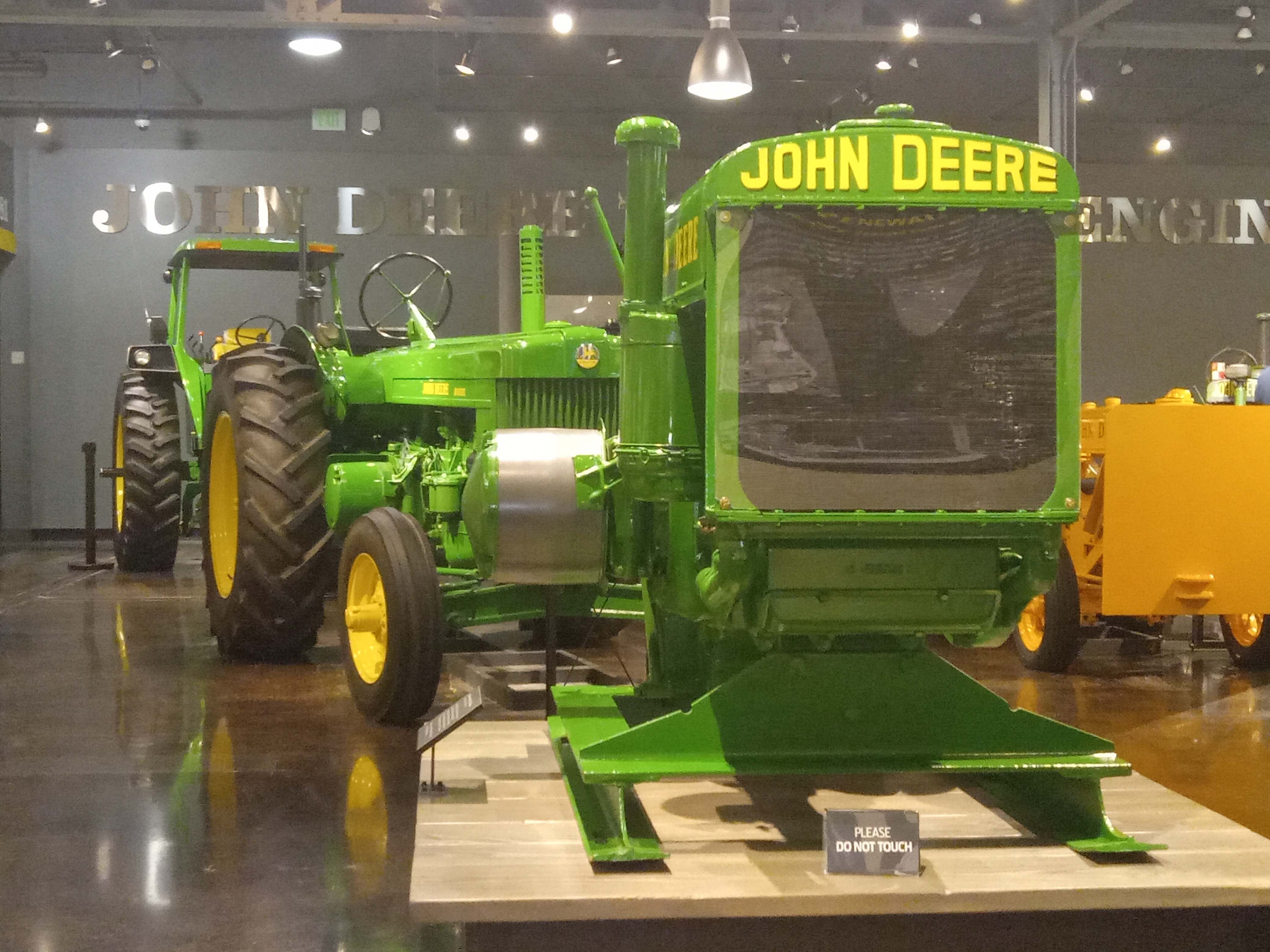
My interest in agriculture has been growing partly out of necessity. One of the magazines I write for covers the industry, and I figure a little more familiarity with the machinery side of farming can’t hurt.
A visit to the John Deere Tractor and Engine Museum in Waterloo, Iowa, offered an opportunity to get better acquainted with the green tractors I have long associated with agriculture.
Even though I’m not personally deeply rooted in agriculture, I’m still intrigued with wondering what a collection of things is all about. I go to places like these to learn things. What sometimes comes out of those visits are unique takeaways, such as when Deere manufactured other things, my hometown being mentioned in a display, and repurposing of architecture.
So yes, you might know something about your hometown you didn’t know about, or there’s something that’s going to pique your interest if you truly take the time to take in everything you see.
When you find yourself wandering into a museum of things that you aren’t heavily interested in, but do have some interest enough to wander in, try to come up with 5-10 takeaways of things you didn’t know. That’s what I did, and will detail as you read this. Things to glean from these experiences make great future conversation pieces, too!
***Click HERE for my full Flickr photo album!***
The museum occupies a former Deere factory, a fitting place to trace the company’s manufacturing history. According to John Deere, the museum sits at the site of its first tractor factory and follows the evolution from a steel plow to modern equipment. Admission is free, making it an easy addition to a trip through northeastern Iowa.
An unstyled Model D tractor greets visitors inside. Model Ds were manufactured in Waterloo from 1923 to 1953; its a machine that bridges several decades of agricultural development. The gift shop sits to the right, while the museum entrance is to the left, with a large painting of John Deere himself nearby.

The museum’s collection follows John Deere’s evolution from its earliest tractor experiments to the machines that helped establish its place in modern agriculture. According to Deere’s own publication, the green line running through the exhibits begins with the aforementioned Model D, and includes an early Waterloo Boy Model R built in 1914. Other notable machines include a replica of the Froelich traction engine, commemorating an 1892 machine credited with being the first gasoline-powered tractor capable of moving both forward and backward, along with examples of later tractor development. Interactive displays even let visitors test their strength against a steel plow, connecting the equipment on display with the physical labor it was designed to replace.
The building’s industrial past adds to the experience. Scars remain in the floor where machinery once stood, which serve as reminders that the exhibits occupy a place where equipment was made and developed. There is something appealing about seeing history preserved in the very setting where it happened.
I am particularly interested in how machines evolve, including seemingly small improvements that make them more practical. A tractor’s canopy or roof, for example, might seem like a minor feature until one considers what it means to spend long hours operating equipment in the sun. Following those changes gives me a way to appreciate agricultural machinery through details that might otherwise escape my attention.
The design evolution of Deere’s tractors was another highlight of my experience. Industrial designer Henry Dreyfuss and his associates helped shape Deere’s styled Model A, B and H tractors in the late 1930s. Their designs gave farm machinery a more distinctive appearance, and I found that transition fascinating. Tractors were becoming recognizable examples of industrial design, with shapes that reflected an era’s ideas about how machines should look as well as work.
Dreyfuss also designed something I have encountered far more often than a tractor: the familiar round Honeywell thermostat. The iconic Round domed dials debuted in 1953. I remember seeing those dome-shaped thermostats in homes where I once lived. Discovering a connection between the designer of agricultural machinery and an everyday household object is exactly the sort of unexpected detail that makes a museum visit worthwhile.
John Deere’s history includes other surprises, too. The company made bicycles during the 1890s and returned to the market in the 1970s. Those later offerings included cruisers and racing bikes, in addition to models for boys and girls. I would not have associated Deere with bicycles, but a company that has produced such a wide range of machinery has had plenty of room to explore other markets. You’d think that would have been a World War II kind of thing, back when manufacturers would switch to making other things either for the war effort or for the homefront.

My interest in Deere also reaches closer to home. John Deere himself made his first successful steel plow in Grand Detour, in Ogle County near Dixon. He developed the plow there in 1837, using polished steel to help the sticky prairie soil slide off rather than cling to the implement. The John Deere Historic Site in Grand Detour preserves the location of his original shop and has live blacksmithing demonstrations, while a marker identifies the general area where the plow was first tested across the Rock River (north of the intersection of Lost Nation and Kingdom roads near Lost Nation Golf Course).
Another connection appeared in the museum’s discussion of early engine development. Sterling, my hometown, has its own place in that history. The Charter Gas Engine Co. adapted a stationary gasoline engine to a Rumely steam-traction-engine chassis in 1889, producing an early gasoline-powered traction engine. The company built six of the machines that year. Seeing Sterling mentioned in a museum devoted to agricultural machinery gave me another reason to pay attention.
The museum offers plenty to explore, from historic tractors and engines to interactive exhibits that help visitors understand the power behind early farm equipment. I may not remember every machine I encountered, but the broader story remains clear: agricultural technology developed through countless experiments, design changes and practical improvements.
This visit was paired with a visit to the National Wrestling Hall of Fame and Dan Gable Museum, also in town. Waterloo has much more to visit – go to experiencewaterloo.com for more information. My Waterloo visit took place after visiting sites in Pontiac, Illinois and the Crazy 80s Car Museum in Dwight, Illinois.
A visit to Waterloo could also pair nicely with a stop at the National Farm Toy Museum in Dyersville, another Iowa destination I explored in my Farm Toy Museum road trip in March 2025. That museum looks at agricultural machinery from a different scale, with collections of vintage and collectible farm toys that show how generations imagined farm life through miniature tractors, implements and farm scenes. Dyersville also is home to the Field of Dreams.
Together, the two museums offer complementary perspectives. Waterloo traces the evolution of the working machines themselves, while Dyersville preserves the toys that brought those machines into childhood playrooms and collectors’ displays. Both make room for the history, engineering and design behind agriculture – even for visitors who, like me, are still learning their way around the field.
John Deere Tractor and Engine Museum – 500 Westfield Ave, Waterloo, Iowa; 9 a.m. to 5 p.m. Tuesday through Saturday; 319-292-6126, click HERE to go to its website


