Baseball card tales: 1971 Topps
One of the most pivotal years in recent American history was 1971.
The Vietnam War was at its peak, protests were all the rage, 18-year-olds could now vote, and CBS’s “rural purge” saw shows that had a tree in it get canned in favor of All in the Family and Sanford and Son.
Recently, an Apple TV+ documentary was made suggesting that 1971 was “The Year That Music Changed Everything.” Indeed, it was quite the year for change.
Baseball cards changed as well in 1971.
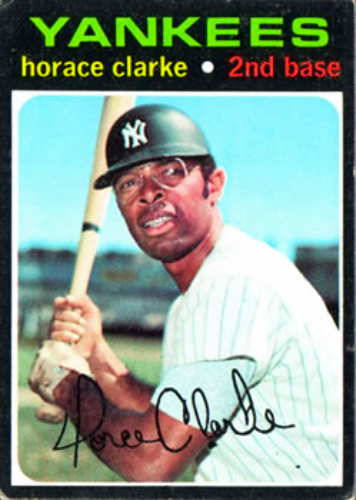
What Topps designed for its 1971 set was a stark contrast from its 1970 set with gray bordering and cursive handwriting of player’s names on the front. Designed in the drawing rooms in late 1970, Topps issued a set that was unlike anything it has done before: Color in-action photography, black bordering, facsimile signatures for only the second time since 1956, all-lowercase player and position names, and black-and-white headshots on the back of the card.
Topps also came out with a coin side set that year, and as a result, short printed some cards of the highest sixth series.
The wax pack box design also was a sign of current times with popular fonts and styles all on a black background. Where 1970 may have felt like a step backward in design progression, 1971 was on-target with the times.
——– Click here for a checklist of 1971 Topps, courtesy of Beckett ——–
Cool shots
The occasional in-action photography and the black borders are the top two hallmarks of the 1971 Topps set.
Topps used to just have stationary pose shots for its cards, some with a posed action and some with just a big head. If there were any color action shots, they looked like oil portraits. In 1968, Topps started adding black-and-white photographs to its World Series subset cards, but they were just like something one would see in the newspapers of the time.
The 1969 set was a photographic disaster for Topps, after a dispute with the MLBPA during the 1968 season. This meant Topps had to use pictures from previous years in most cases, only when the matter concluded after the beginning of the 1969 season, Topps started featuring people in the expansion uniforms (Pilots, Royals, Padres, Expos) with the later sets. Needless to say, with no disputes effecting photography for 1970 cards, the 1970 set was much improved from 1969, and even 1968 with the addition of more candid poses.
What would top 1970’s photo improvement? In-action color photography, which would become a more cheaper process by this time (Go to thecameralabs.com/why-did-photographers-not-use-color-before-1970 for a rundown of this situation). The expansion with four new teams, and as a result the new divisional play format, made baseball a more popular game, and the card companies sought more efforts to improve upon their previous years.
Just less than 1/8th of the 752-card set would have action photos, with most games shot at either Yankee Stadium or Shea Stadium in Topps’ home base of New York City. Home plate was where much of the action was, and that’s where the photographers were for most of the in-action card shots; and that meant that home team catchers Thurman Munson of the Yankees and Jerry Grote of the Mets were in the backgrounds of many.
Topps’ first in-action photograph card was No. 5, that of Munson himself. On that note, the 1971 set also was the first that had a few horizontal cards in a set of mostly vertical ones. Munson’s card has become more popular than his 1970 rookie card in this respect. His vertical card is shown with him making a tag at home plate under a cloud of dust against the sliding Chuck Dobson. That card also includes the Topps’ All-Star Rookie icon on it. What a start to this concept! Most other photographs for the in-action cards in this set, though, wouldn’t have been chosen from a slim pickin in later years.
Brooks Robinson, Joe Torre and Bob Gibson are future Hall of Famers with in-action base cards in this set.
Those borders, though
Unique borders make a card stand out, look no further than 1955 Bowman (TV set) and 1962 Topps (wood). Black may seem like anything but unique, but no set had ever had such borders before. Topps wouldn’t go to black borders again until a small section of the 1986 set, and its popular 1985 football set.
Black borders have become more common in recent years with more improved card stock. The next set to go black-border after 1971 Topps was the 1991 vintage baseball set issued by Conlon and The Sporting News. Then came Pinnacle’s 1992 debut and Leaf’s black gold subset the same year. However, Topps’ 1971 cardboard stock was susceptible to chipping and noticeable corner wear – meaning it was and is tough to find the cards in the desirable conditions.
It used to be that sellers could cheat and replace the brown wear with black permanent marker, but the concept of computerized card grading was just a twinkle in a collector’s eye in 1971. The search always continues for grade improvements on these cards for vintage collectors. During my vintage card searches at card shows, I have noticed that the selection of 1971 cards is much smaller than 1972 or 1970 – that’s because these cards are still in demand.
The borders, and the chase for finding better ones, has led to cards in this set being more expensive than those in 1970. This is especially true for the very scarce Greatest Moments side set made by Topps that year, with similar black bordering.
Rookies and managers
Only one Topps base set issued between 1954 and 1983 has zero future hall-of-famer rookie cards: 1970, led by Thurman Munson, Bill Buckner and Darrell Evans. The 1971 set also had a long drought of 40 years before one of its rookie card class members, Bert Blyleven, became a Hall of Famer. The second Cooperstown member from the rookie card class came to be in 2022 with Ted Simmons.
The rookie card class of 1971 doesn’t lack in numbers, though when it comes to All-Star appearances. Along with Blyleven and Simmons, there are also Dave Conception (14), Ken Singleton (16), Bobby Valentine (188), Bobby Grich (193), George Foster (276), Steve Garvey (341), Greg Luzinski (439), Al Hrabosky (594), and what could be Topps’ best three-player rookie card ever made in No. 709: Don Baylor, Dusty Baker and Tom Paciorek.
As far as managers are concerned, more than one-third of the manager cards are of then-current or future Hall of Famers: Walt Alston (Dodgers), Sparky Anderson (Reds), Leo Durocher (Cubs), Gil Hodges (Mets), Bob Lemon (Royals), Red Schoendienst (Cardinals), Earl Weaver (Orioles), Dick Williams (Athletics) and Ted Williams (Senators).
The set also features the final base cards of future Hall of Famers Ernie Banks (525) and Jim Bunning (574).
Checklist rundown
I took a quick glance at the checklist of cards and threw together some observations I had. The Munson and Baylor-Baker-Paciorek cards are two of the most popular and interesting, but there is a third card that I also find especially intriguing. Can you find it among the list below?
——– Click here for a checklist of 1971 Topps, courtesy of Beckett ——–
1: The Orioles World Series team card marked the second time this kind of card was done, after the Miracle Mets to kick off the 1970 set. The only other time this was done was with the 1972 Pirates set, a team card which is notable for having the players who made up the first all-Black lineup of Sept. 1, 1971.
2: Someone with one of the most interesting stories of the 1970 season kicks off the player cards, Pirates pitcher Dock Ellis. He hurled a no-hitter on June 12 under the influence of LSD, though it was not known at the time the card came out.
5: This is the iconic Thurman Munson card, and the first player card to be horizontal since the final one of the 1960 set.
18: Norm Miller’s in-action card (Astros) is the second one in the set, and features Grote at catcher. The Astros-Mets series is prominently featured in other cards in this set.
35: Lou Piniella (Royals) has an in-action card. This one is the first in the set that you can get a clear view of the fans in the stands.
63: The AL RBI Leaders card features runner-up Tony Conigliaro as a member of the Red Sox. This shot was actually taken from his 1970 card. Conigliaro’s 1971 card, No. 105, has him as a member of the Angels, and thus an airbrushed uniform.
73: Not a real important card, but it is the final Topps card of George Brunet (Pirates), who would play professionally for a record 36 years from the mid-1950s the the late 1980s, most years in the minors or in the Mexican League, where he is a member of its Hall of Fame.
148: Johnny Mayberry (Astros) has a cameo background appearance by Joe Morgan in one of two cameos by the legendary second baseman.
195: The League Playoff series cards run from 195 to 202. Game 1 for both leagues was marred by an umpires strike, and replacements were used for that game in both the AL and NL. Card No. 195 is Game 1 of the ALCS and features one of the replacement umps in the background, John Stevens. Called out of the umpiring administration office for this game, this is not Stevens’ only appearance on a baseball card, and he was one of the ones on the 1955 Bowman set.
213: Frank Baker’s rookie card from the Yankees. Frank Baker also was the name of a former Yankees Hall of Famer in the late 1910 and early 1920s, nicknamed “Home Run” Baker. This 1971 Frank Baker finished his career with just one home run. Another Frank Baker appears on card No. 689, but with the Indians.
264: Joe Morgan swings at a pitch at Shea Stadium, and you’d only know that by his uniform number and name on the card. Today, this shot would be rejected for cards: Morgan’s face is nowhere to be seen in this shot, just the back of his head. Grote is catching.
275: Another Thuman Munson cloud-of-dust picture, but as a cameo for Vada Pinson’s card on the Indians.
278: Jerry Grote has been in a couple of action cards already, why not feature him in one of them? He’s taking off for first base, but his head’s down and you can’t see his face.
289: The White Sox team card features Southside great Luke Appling in his first appearance as a coach.
310: Another Joe Morgan cameo, this time on the field for a sliding Tommie Agee.
339: Wayne Simpson was one of the biggest pitching stars for the National League champion Reds in 1970, winning 14 games against three losses before tearing a rotator cuff that derailed his career. One of those “what if” moments. Simpson’s rookie card is in the highest series of the 1970 set.
342: Frank Tepedino didn’t have a memorable baseball career, but he was a first responder (FDNY) at the 9/11 attack at the World Trade Center. Like Simpson, his rookie card also appears in high-series 1970.
355: The most notable cameo on Bud Harrelson’s horizontal in-action card is a young Nolan Ryan with his back to the camera, while Harrelson is making a tag at second base of an Astros runner. There has been debate as to who that runner may have been; some thinking that it was Joe Morgan (and would have been Morgan’s third cameo on a card in this set), but it very likely appears that it is really Jimmy Wynn. Either or, it’s not often where there’s a double cameo of star players on a single baseball card.
370: I need help with determining who is in the background of Joe Torre’s in-action card. He is at bat, and it looks like Ted Simmons is in the on-deck circle, with maybe Lou Brock in the dugout? If that is Simmons, it could make sense as Torre would have taken over third base for Mike Shannon at this time (more on Shannon later).
395 and 514: Roy White and Ron Woods, respectively, are in similar horizontal in-action photographs for the Yankees; both at-bat with the White Sox’ Chuck Brinkmann catching.
450: Bob Gibson is on the mound, likely Joe Torre on third base.
485: Ken McMullen (Angels) is in-action on third base, with a neat background shot of Yankee Stadium’s Memorial Park. For those who don’t know, the monuments and flag pole were in play at the stadium until its mid-1970s renovations.
——– Click here for a checklist of 1971 Topps, courtesy of Beckett ——–
502: This is the first of a few appearances of mug shots and signatures on the Chicago Cubs team card up until 1981. The way it worked back then was that each team would send Topps a team photograph to use, but the Cubs sent their team photographs in such a manner.
511: Phillies pitcher Chris Short is throwing a pitch with the Reds’ Pete Rose leading off of second base.
535: Curt Flood did not last long in 1971 as a Washington Senator, the team he would be listed on in this card. Flood famously sat out the entire 1970 season in his fight against baseball’s reserve clause. The back stats for Flood in that year show all zeroes.
543: The “missing Mantle?” The Yankees team card appears to have Mickey Mantle on it from his brief coaching stint in the summer of 1970. I’m going to give credit to Junk Wax Hero on YouTube for this information: https://www.youtube.com/watch?v=8SyL2hIQFvo
544: Vida Blue is smiling and has his hand out in front of the camera. Blue’s legendary 1971 season with the A’s make this card more popular and valuable than his 1970 rookie card that he shares with Gene Tenace.
554: Like last year’s rookie card, Phillies pitcher Lowell Palmer is shown once again with his “D.B. Cooper” sunglasses. This wasn’t the case next year, as his high-series 1972 card with the White Sox shows him in partial shades.
588 and 679: This was one of the “Blue Sox” uniform years on the South Side, and these cards of Tom Bradley and Don O’Riley feature very ugly light blue airbrushed caps; Bradley without and O’Riley with the Sox logo.
650: My favorite card in this entire set is this one of Dick Allen.
1) The photographer’s left knee is visible at the bottom left of the card.
2) It’s a short print.
3) This is Allen’s only Topps base card as a Dodger (he also appears in the Topps Super set in Dodger colors).
4) This card features Allen with the bushy hair, facial hair and glasses he would later wear with the White Sox. The interesting thing about that ties in to his 1970 and 1972 cards. Allen’s 1970 card features him clean-shaven and looking to the right from the camera with team name and logo airbrushed due to his move from the Phillies to the Cardinals. Allen’s 1972 card used the same shot as the 1970 card, making Allen go from clean-shaven to hairy to clean-shaven again.
666: The 1970 set was the first to feature a card No. 666, and the 1971 set does, too. This year’s card is that go Gene Brabender of the Angels, who would not pitch at all for the Angels, or at all – period – after his 1970 season with the Brewers. What (bad) luck, Mr. Guy on Number 666. The guy on No. 666 in 1970, Adolfo Phillips, also did not play at all in 1971.
698: This is the first Milwaukee Brewers team card, who played in 1970 after an infamously rough start as the Seattle Pilots.
714: Dick Williams appears in airbrushed Athletics green – with an ugly bright green hat – before leading the club to back-to-back-to-back championships from 1972 to 1974. Williams came to the club after serving much of the 1970 season as a coach for the Expos, and thus also appears on Montreal’s team card.
715: Horace Clarke’s card isn’t anything special, but he accomplished an interesting feat in the span of less than 30 days in 1970. Clarke broke up three potential no-hit bids in the ninth inning, Jim Rooker’s on June 4, Sonny Siebert’s on June 19, and Joe Niekro’s on July 2. Only Clarke and Joe Mauer have done such a thing that many times in a season, but Mauer didn’t do it during such a short span as Clarke’s.
735: Mike Shannon is featured on a short-printed card. Shannon, a Cardinals legend both on and off the field, battled a serious kidney ailment that forced his playing days to conclude less than one-third of the way through the 1970 season. He had hoped to make a comeback in 1971, but that didn’t happen.
My first 1971
Concluding this entry on 1971 Topps, the very first card I bought from this set was the Senators’ Frank Howard.
I had read about baseball stars of days before my time in an old encyclopedia, and learned about Howard hitting nearly 400 home runs. I didn’t get my hands on a card from this set until visiting Sterling’s only baseball card shop – Home Plate Sports Cards on East Fourth St. downtown – and sifting through the $1 box of vintage cards. I was probably 13 years old at the time.
At that time, I didn’t even have a Senators baseball card. So this fit three firsts: My first Howard, my first 1971 Topps and my first Senators card. I later bought a Senators team card in that box, along with cards of Willie Horton, Jerry Reuss and Lee May. Many years later, I would come to realize that none other than Ted Williams (manager) and Nellie Fox (coach) were pictured within that card.
I hope you enjoyed this rundown of the iconic 1971 Topps set.
Do you have an interesting story, or a story behind the card tale, of something in the 1971 Topps set? I love to hear it. Contact me at shs42886 at yahoo dot com.
 Cody’s Road Trips