Diamond standard in railfanning
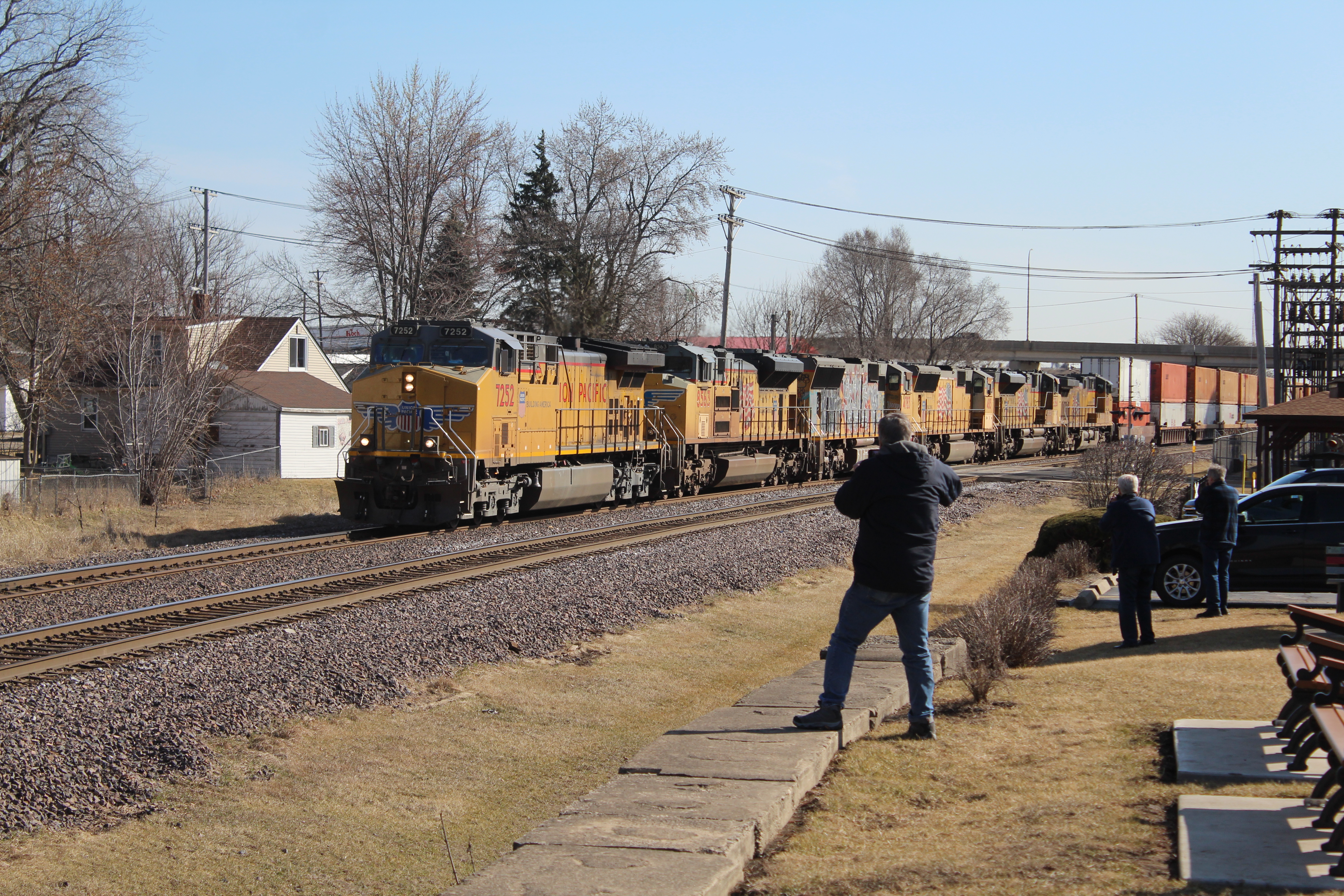
Despite being only 80 miles from downtown Chicago, Rochelle is home to an intersection of two major railroad lines going from the big city toward the west coast. It’s also a place where lovers of all things railroads gather to get close to the big machines and marvel at certain rail traffic particulars they wish to see.
Rochelle has been the location of a diamond intersection with the Union Pacific’s Overland Route and BNSF’s Northern Transcon since the early 1870s, but it wasn’t until 1998 when the spot became a place to safely flock to without getting in the train’s way too much.
— Click HERE for my Flickr photo album from my trips —
The Ken Wise Rochelle Railroad Park attracts railroad enthusiasts from all over the world, gathering at the wedge-shaped park east of one of the intersection’s acute angles to see what engine, cars and payload will meet their eyes. With two busy rail lines, the chance of seeing a train go by is much greater here than parking at a typical railroad crossing out in the country.
The park has a picnic shelter, gazebo, benches, replica hobo shelter, small outdoor grill, and two smaller engines that once were used for Rochelle’s thriving industry in decades gone by. A gift shop with railroad items for people of all ages, handicapped accessible restrooms and a small viewing area toward the BNSF line also is on site, and open from Wednesday through Saturday during non-winter months.

Trains are an interest to many people, and there are people who enjoy the many sub-genres of it. These people can see a train that someone who wouldn’t care wouldn’t think twice about and marvel at the many intricacies that it possesses. They’ll look at the shape of an engine and say that they haven’t seen one of those in years, or find a grain car with a logo of a long defunct company and consider it real interesting. There are many other details that become picture worthy to enthusiasts, but they are beyond me.
My dad’s parents lived on property next to the UP line in Sterling, about 30 miles west of Rochelle, for more than 45 years (my cousin lives there now). The roar and rush of the trains were a common sight at my grandparents’ house, whether it was through their large living room window, or as up close as us kids were allowed to get in their back yard. Chicago and North Western green and gold transitioned into UP red and gold after 1995, and there were several times when I would spot something different during my visits. I now live a block away from the UP line and take note of anything different when I see something zoom by from my own living room window.
Why is train viewing interesting? Let me go off-topic from the park itself for a moment to point out a few reasons.

Companies have their usual engine color and design schemes: UP’s red and gold, and BNSF’s arrangement of green and orange. Sometimes the companies will create special paint and design schemes for promotion or historical tribute sake. My favorite is UP’s “1995” tribute engine, decked out in Chicago and North Western green and gold. To me, it brings back memories of the engines I saw long ago. I last saw this one last fall when it stopped at a grain facility in Sterling for a couple of days. Union Pacific also has tribute engines for those companies that have since merged into it, such as Southern Pacific. The BNSF engines tend to stick to its current design, but one never knows when they’ll see an old black-and-yellow or silver-and-red Santa Fe engine, or a green-and-white Burlington Northern engine behind the lead.
Sometimes the cargo is interesting: Some have a mile’s worth of John Deere tractors on cars in full view.
“Is that an old Rock Island logo from the late 1970s on that grain car? Whoa.” There aren’t many Rock Island cars left, after the company went bust in 1980.
Unfortunately, cars are vulnerable to graffiti artists. Despite the fact that they shouldn’t be doing what they do, some of these colorful “artworks” wind up being interesting.
Special historic engines make nationwide tours, such as Union Pacific’s “Big Boy” steam engine, which made an appearance in Rochelle last year.
I always want to see a mixed freight train because of all of the different things it carries. It’s more enjoyable, in my opinion, than seeing the same coal cars and intermodal boxes.
I’ve been to the park several times, but made two visits to there in early March. I found a couple of different sights from the norm on both occasions. On the first visit, I learned that cabooses are still a thing on the tracks. I thought they were long gone by the mid-1980s. BNSF still uses one, colored in Burlington Northern green, that went by on this visit. I talked with the gift shop clerk about it, and apparently it comes by every so often. On the second visit, a black-and-white Norfolk Southern engine was leading a line of cars on the UP line. You don’t see that every day, but there is a reason for it. If I visit again, maybe I’ll see something else; you never know unless you visit.
Such aforementioned interests are shared by others. Rather than standing out at a crossing in the middle of nowhere, having a dedicated park to gather at brings people closer to similar people, and if you’re curious about something, another visitor might just have the answers.
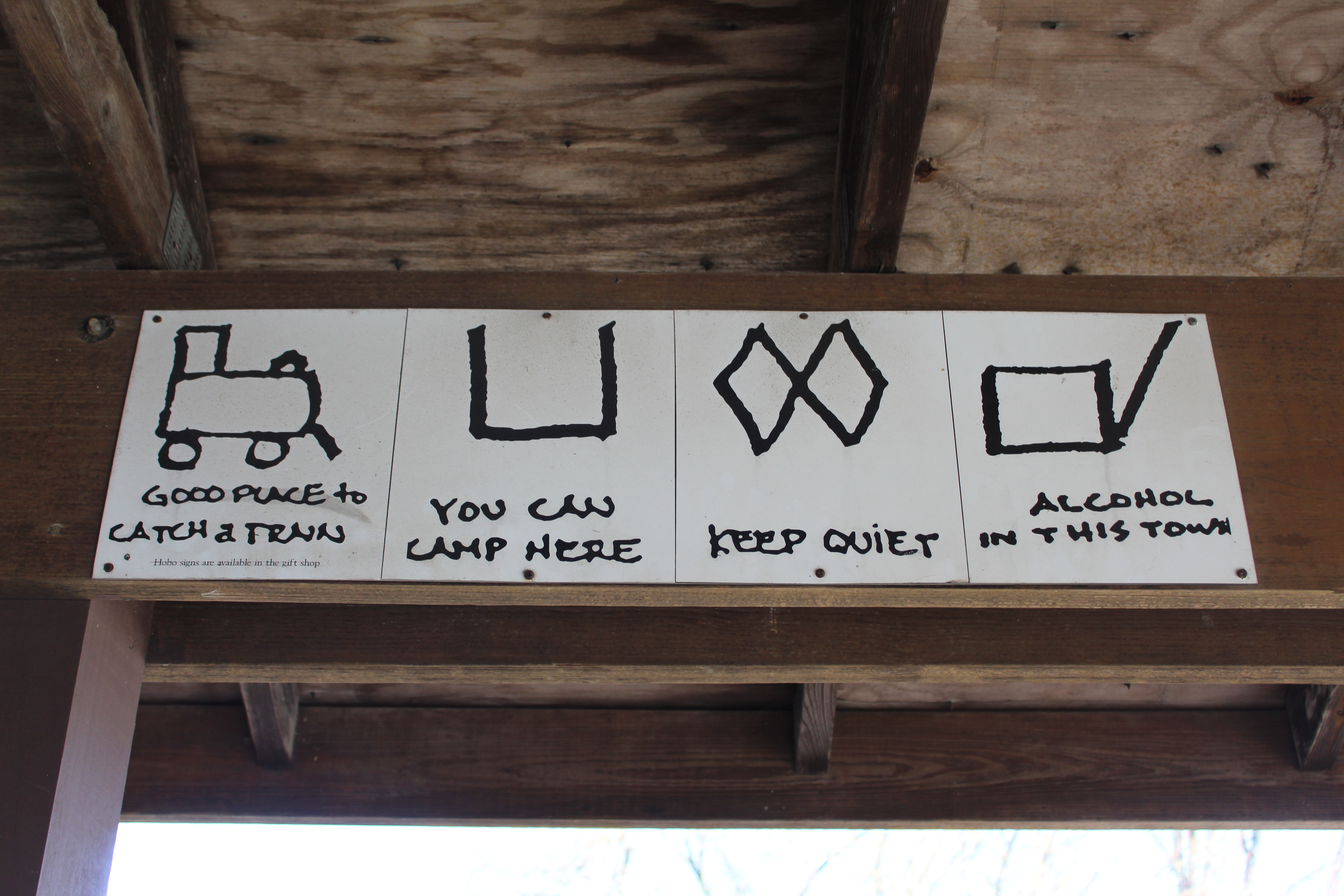
The large picnic shelter contains displays of hobo symbols, used by them to identify such things as safe camping and where to get some alcohol. Union Pacific’s radio communications also are heard within the shelter. A webcam on top of the shelter shows 24-7 activity looking toward the diamond junction, and is available HERE.
Inside the gift shop, mementoes from Rochelle’s railroad history are on display. Rochelle Township High School’s nickname of the “Hubs” comes from the railroad and industry it brought to town. UP has an intermodal facility nearby, and the town once was home to a Nippon Sharyo plant that made rail cars.
Not much is shared about the history of the two lines themselves. Chicago and North Western built its line through town in 1854, and the Chicago and Iowa (later Chicago, Burlington and Quincy; and then Burlington Northern) came to town in 1871. Trains have been making clanking sounds on the diamond crossing for more than 150 years. The UP stretch in Illinois is known as the Geneva Subdivision, and the BNSF one is known as the Aurora Subdivision.
One lesser-known story about railroading in Rochelle is that the Chicago, Milwaukee and St. Paul (the “Milwaukee Road”) also went through town on shared concurrence with the CB&Q from Steward to Flagg Center for a few decades. This Milwaukee Road line went south from Racine, Wisconsin to a coal mine in Cherry – the same mine that had a major disaster in 1909 that killed more than 200 men and children working in the mine. Coal from Cherry made its way through Rochelle at that time. The Steward to Cherry (later ending in Ladd) stretch was abandoned in the early 1980s; the line from Flagg Center going north is semi-abandoned with rails remaining but rarely any service. There is a Milwaukee Road caboose that sits on private property near the park.
Some visitors to the park can interpret the UP radio dispatch easily, ordinary people can’t. When there’s no activity at the diamond, the faint sound of a whistle gets people’s attentions. But where is it coming from? It can be hard to tell. You know a train is coming when it makes, in succession, two straight long whistles, then one short one, and then one more long one (a sequence required for all engines when approaching a train crossing). The park is located on Ninth Street, and has two crossings near one another. When those crossings make sounds, it’s a matter of finding out which one is flashing red and having its gates go down.
The junction is one of many throughout Illinois, but among the most busiest. There are other junctions in Joliet, Blue Island and Park Forest with plenty of traffic, but none like Rochelle where one can get close to the lines. Other junctions have a busy line crossing a seldom used one, such as in Davis Junction (15 miles north). Other junctions aren’t quite as busy as Rochelle’s; the one in Savanna comes to mind, 60 miles west on the BNSF, where it crosses a Canadian Pacific line, but there aren’t as many trains on the CP.
If you enjoy the sounds and sights of trains, and want to have conversations with other train lovers, the Ken Wise Railroad Park is your place.
Ken Wise Rochelle Railroad Park
124 N. 9th Street, Rochelle
Rochellerailroadpark.org and Facebook – go online for up-to-date gift shop hours.
I will feature another Ogle County railroad watching spot soon. That story comes from my magazine archives.
 Cody’s Road Trips