Seeing Sheen: Peoria’s venerable Catholic son
Cody’s Note: This road trip is dedicated to my late friend The Rev. Monsignor Richard Soseman, who played a major role in the cause for Archbishop Fulton J. Sheen’s canonization for sainthood in the Catholic Church. Soseman was a colleague of mine on Illinois High School Glory Days, and spent much of his years as a minister at the Peoria Diocese. He worked in Rome for a few years while leading the Sheen cause. Originally from East Moline’s Campbell’s Island, Soseman later returned from Rome to serve in the La Salle-Peru area before his death from coronavirus in 2020. Soseman’s work on Sheen’s cause inspired me to visit the Peoria Diocese’s Sheen Museum in town.
***
The Catholic Church has been worldwide for many centuries. Its leader, currently Pope Leo XIV, is from Chicago and is the first United States pope. Pope Leo is seen as a more modern pope, and when he was young, the Catholic Church had gone through tough times with the Second Vatican Council of the early 1960s. Television was starting to be a norm in the American home at the time, and the future Leo wouldn’t have thought otherwise.
Among the possible shows that a young Robert Prevost could have watched was “The Fulton Sheen Program,” which itself is a newer version of Sheen’s most popular show, “Life is Worth Living.” Using television as a means to promote the church’s teachings, especially in a trying time, has been crucial in keeping the church an important part of Catholic’s lives.
Fulton J. Sheen embraced the new technology of his time, and as a result helped usher the church into a new age. That journey began in Peoria.
Sheen was born about a half-hour east of Peoria, in the small town of El Paso, in 1895, and his family soon moved to Peoria. Along with seminary studies, he was also a football player for St. Viator College in Bourbonnais (a predecessor to Olivet Nazarene University). He was ordained at St. Mary of the Immaculate Conception in Peoria in 1919, and later served as auxiliary bishop of New York City, and Bishop of Rochester, New York. Along the way, he began preaching on radio with NBC’s “The Catholic Hour” in 1930 before launching his television shows, which last were taped in the late 1960s, but forever rerun on networks such as EWTN.
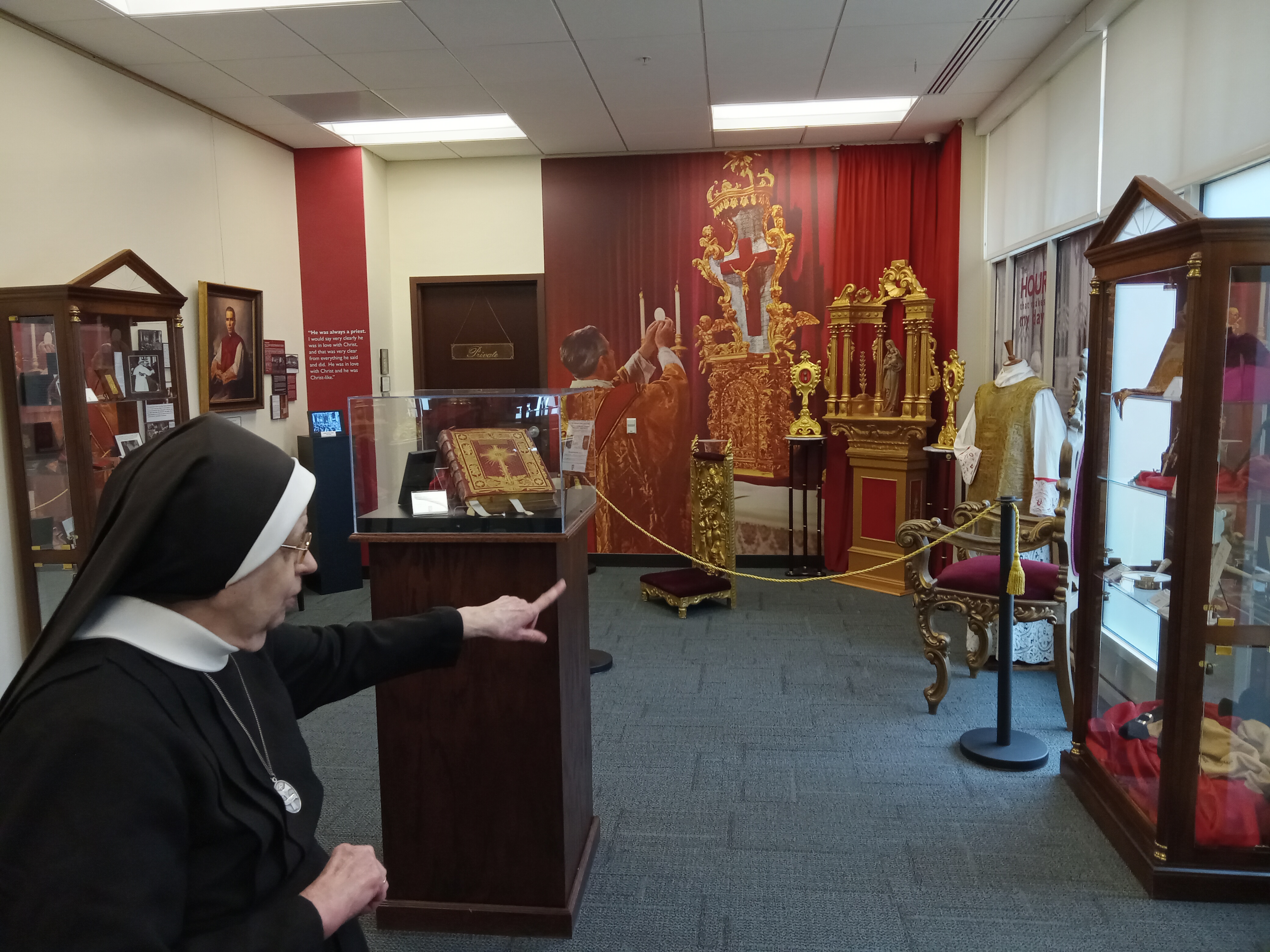
Never forgetting where Sheen came from, the Peoria Diocese opened a small museum in his honor at the diocese headquarters in downtown Peoria. It is free (donations accepted, of course) and guided by one of its Sisters.
*** Click HERE for the Flickr Photo Album of this place ***
The museum takes visitors on an artifact tour from Sheen’s early life up to his death, with mementoes from college to the many honors (most in the form of keys to cities) he’s received. Some of his media is present as well, including a reel from one of his “Live is Worth Living” programs – which, I told the Sister, is especially neat to have considering that the company it broadcasted on, Dumont, didn’t last long and many of his archives were dumped in the Upper New York Bay.
A video presentation of Sheen’s life is available to watch, and Mons. Soseman is part of it.
After going through the museum, one will get a sense of just how large Sheen’s contributions to the church were through medium. Being in journalism, I am well acquainted with the power of technological mediums, but his efforts brought the Catholic Church well past Sunday mornings and kept it relevant as worldly attitudes changed in the 1960s.
Not many people would know that there is a museum about Sheen. It is a must visit for those in the Catholic Church who want to understand today how their lives through Christ have shaped and influenced. Radio was just picking up steam when Sheen first broadcast “The Catholic Hour,” and the medium became immensely important during the next 20 years – and then television came. Sheen’s programs eventually led to the church’s presence on a channel (the aforementioned EWTN) and that begat its presence online as we see today.
The Peoria Diocese is observing its 150th anniversary this year.
Next to the Sheen Museum are two former high school buildings, Spalding Institute and Academy of Our Lady. The Spalding building is the more ornate of the two. The high schools existed up to the formation of Notre Dame High School in 1988. A couple of blocks to the east is St. Mary of the Immaculate Conception. Sheen’s remains were moved there about a decade ago. The limestone building is wonderfully lit up at night.
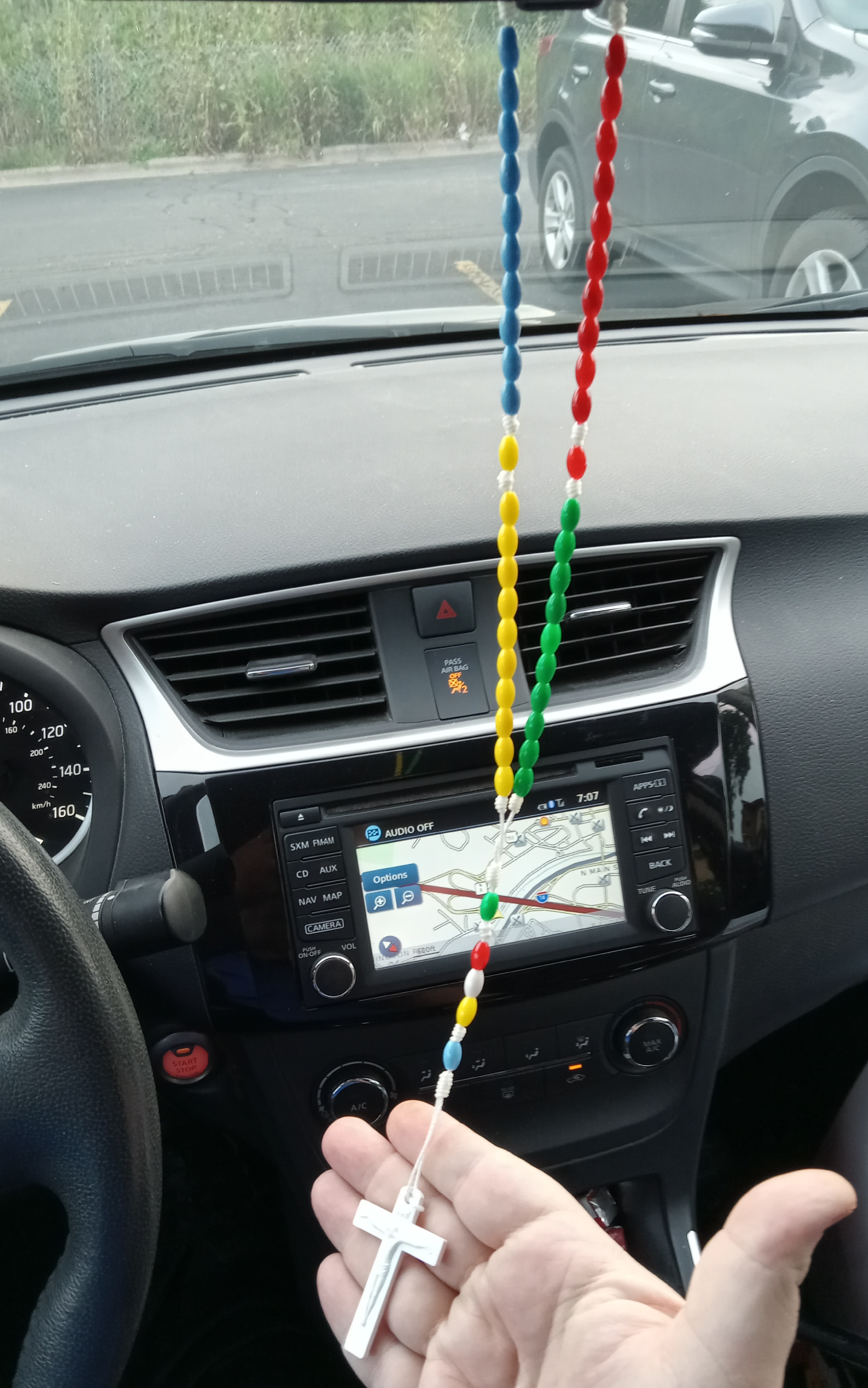
One of the souvenirs I bought from the museum is the Sheen Rosary. It hangs from my rearview window today.
Fulton J. Sheen Museum
419 NE Madison Avenue, Peoria
Online: https://www.celebratesheen.com/museum
Open: 9 a.m. to 4 p.m. Monday through Friday
Contact: 877-717-4336
Elsewhere in Peoria
I had planned to make a stop at the Caterpillar Museum in downtown Peoria, and the Peoria Riverfront Museum as well. I got through the Caterpillar Museum, but felt ill while going through the Riverfront Museum, so I paused the trip mid-day. I plan to have a separate post on both places the next time I visit Peoria.
Coming up
My annual Fall Road Trip week in mid-October is fast approaching. I plan to drive down Illinois Route 1 for its entirety; it is the longest state route in Illinois. This is the plan, and I hope it doesn’t change.
 Cody’s Road Trips