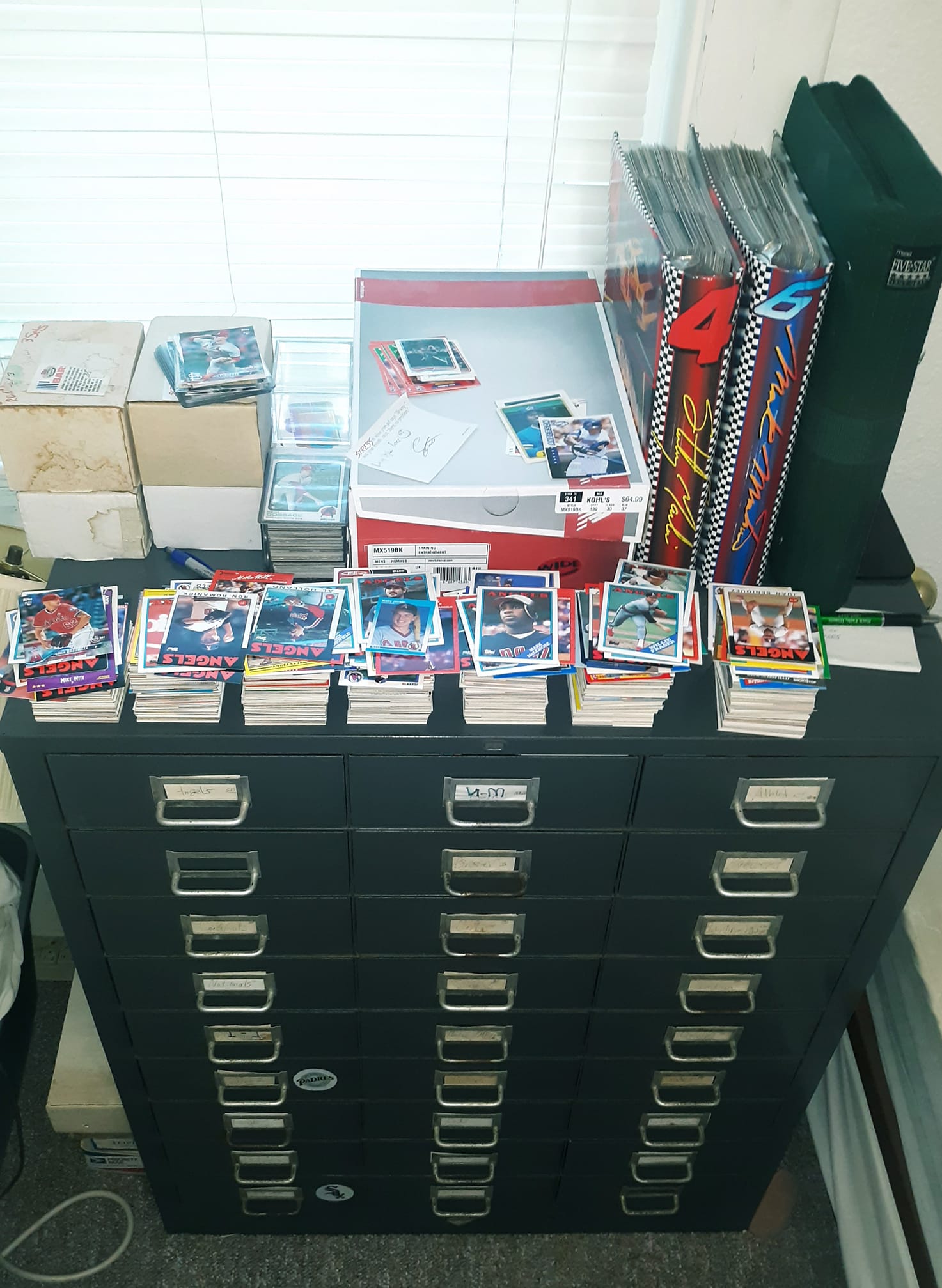
(NOTE: This post isn’t about road trips. It is on baseball cards, which is also an interest of mine. There are only a couple of elements in this post that have to do with actual travel. I don’t make these kinds of posts often, but my website is a platform where I can share my thoughts in such a subject larger than what I can on social media. I do make some road trips to sports cards shows and stores, and I may make a post about those some time. – Cody).
Reclamation of junk wax baseball cards is on my mind today.
Boomers and the older flock of Generation X were told that their baseball cards would be worth more if they saved them and took care of them. Those same people told their kids the same thing about their new cards during the 1980s and 1990s.
Not really.
The “junk wax” era peaked from 1987-92 due to mass production, and its bookends go as early as 1981 and late as 2000. A 1992 Donruss card of a player no one remembers anymore was worth $0.05 in 1992. It is still worth $0.05 today. It will still be worth $0.05 33 years later, and even 66 years from now when the U.S. Mint may consider ceasing production of the nickel (like it is with the penny today).
I have some friends who have turned these “junk wax” cards into visual appeal for home decor: tables, dressers, epoxied into coasters, stuff like that. The restrooms at Rookie’s Food and Spirits, a bar/grill in Mazomanie, WI, has its walls decorated with grids of baseball cards. A few years ago, I saw a man at a card show in Peru, Illinois who cuts out specific parts of cards and creates new ones as art.
But what about cards of star players? It depends on the star. From 1987 to 1992, Nolan Ryan cards are worth more than any other veteran player in sets during those years, in most situations. The next rung below are players like Barry Bonds, Ken Griffey Jr. and Mark McGwire. The bottom rung cards are what we call “commons,” cards of players that no one remembers today. The next rung closest from the bottom is what Beckett, a longstanding source of card pricing, calls its “minor stars” tier. This minor stars tier includes Hall of Fame players such as Gary Carter, Paul Molitor and Carlton Fisk – whose cards in the aforementioned 1992 Donruss set are only worth $0.10 (the Ryan, meanwhile, tops at $1).
Star cards have very little chance in moving up in price, as opposed to the commons. But even 66 years from now, you won’t see those 1992 Carters, Molitors and Fisks reach $0.50). Even if they die, as was the case for Carter.
The cheapest rookie cards of Hall of Famer Larry Walker, found in the 1990 sets of Bowman, Donruss and Score, are only worth $1. They moved to that amount 20 years ago, back when he was still playing. But that’s not always the case: manager Jim Leyland, whose rookie card appears in 1987 Topps, and his XRC in 1986 Topps Traded (XRCs are a whole different discussion for another time) DID go up upon his recent induction to Cooperstown.
About 98% of junk wax cards just aren’t going to move. There are still unopened cases (we’re talking cardboard warehouse boxes with multiple retail boxes inside them) that exist, and there’s not even a market for those. That’s how bad the mass production was.
So what do we do with these cards? I have some ideas for those that I do not wish to keep. Out of my approximately 40,000 cards, I figure that there’s only about 8,000 that I’m keeping for years to come.
Ultimately, it is up to you to decide what cards you truly want to keep. With the others, I’ll offer a running list of suggestions (which will be updated upon coming up with future ideas) …
The decor route
A standard-sized baseball card is 2.5″ x 3.5″ for cards with vertical fronts or backs (3.5″ x. 2.5″ for horizontal fronts). 10 vertical cards in a row is 25″ (2 feet, 1 inch); 10 vertical cards in a column is 35″ (2 feet, 11 inches). Surfaces of things come in various sizes.
Unconventional-sized cards that are bigger, such as 1989 Bowman and 1994 Fleer Extra Bases, require some math to mix them in with standard-sized cards. Some cards are smaller than standard, but can be “framed” into 2.5″ x 3.5″ if placed on top of a colored surface.
It is also possible to overlap cards slightly in order to eliminate the card’s borders looking like a grid (the thickness, however, will be different). Most cards are 0.035″ thick [click HERE for a guide]. If filling in depressions on a surface, cards may be stacked to make a surface smooth, but that would require cards to be glued together to make that happen – and if you’re going to glue ANY cards below another to create larger thickness, be sure that they are of really obscure players.
Most times, a grid of cards won’t fill surface space. In these instances, it’s okay to slice them to fill the gap. It is possible to take a sliced card and align both pieces on opposite ends of corners of angles.
Card art: The person I mentioned who sold his creations at the Peru card show I mentioned can break a single baseball card into multiple pieces and reassemble them within a standard-card sized frame, with the thickness varying on certain areas of the card.
Take a look at the baseball card below, and ask yourself how many different pieces can you carve out of it?
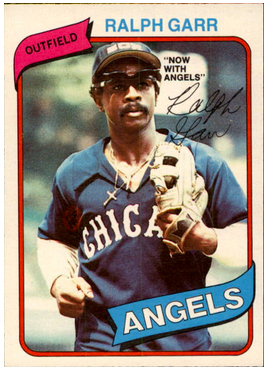
“Angels,” “Outfield,” and “Ralph Garr” are three pieces. The nine letters in his name and the six letters in the team name are 15 pieces, and combinations of letter positioning (“gel,” “ph,” “arr,”) also make pieces. Heads can be cut out and replaced on cards of the same person. Borders can be carved out and placed on cards that do not have borders. You could probably think of more ways.
Sure, Photoshop can make the work a little better, but the layers on card art is what makes it interesting and gives them the visual, sort of three-dimensional pop.
Just remember, once you cut a card, you’ve cut it forever. If going that route, be cautious of this fact.
Labeling: An idea related to the card art idea above, rectangular cuts of certain things on cards can also make labeling more fun than simply putting your handwriting on something. Slicing off the team name on 1986 Topps and pasting it onto a box, or marker on a sales box of cards is one example. Rectangular cuts for player’s names also helps. Those Fleer Star Stickers cards of the 1980s and early 1990s also are good for this.
Brick ’em: I personally wouldn’t do this, but cards can be glued into bricks. This isn’t always easy, as it will take time and precision to make the brick have smooth surfaces. A standard trading card weights approximately 1.8 grams; 250 cards is approximately 1 pound, and about 7.5″ tall.
If you’re going to brick, mixing different card edge colors will give it that random “stacked cards” feel.
Bookmarks: Having a baseball card wedged between two pages looks better than folding a corner, IMO. They are also a little more sturdier than a post-it note.
As package protection: Several card sellers on eBay will use inexpensive cards to protect 1 or 2 cards someone buys before they are shipped in an envelope. I have received common cards this way during my eBay buys, and they just wind up in my junk box.
Sturdier playing cards: Paste a playing card onto a baseball card. Set a single playing card down on a surface and quickly wave your hand over it. Did the rush of air move it? Now do that to a pasted card. It won’t move as much.
Sturdier small photo strength: Those wallet-sized photos of your child can be flimsy. I actually don’t put mine in wallets. If I don’t have a frame for them, I have taken a thin plastic penny sleeve and put a random card inside it, and the wallet photo on one of the sides. Kid’s favorite player on a card, the better the keepsake.
Puzzles – large and tiny: Each baseball card can be carefully carved into multiple tiny pieces to be assembled. Even a rectangular grid of 15 cards works, as long as the end goal is to assemble the puzzle in what you want the 15-card grid to look like.
Kids’ learning tools: Backs of cards have a wealth of information. Biographical data can be made into reading comprehension questions, and statistics make all sorts of math questions. What’s the combined career batting average of players in a stack of cards? The kids may even keep the cards afterward!
I’m going to stop here for now.
If you have other suggestions, I will include them in this list and credit you for the information; you can comment on this post or reach me on my socials.
 Cody’s Road Trips