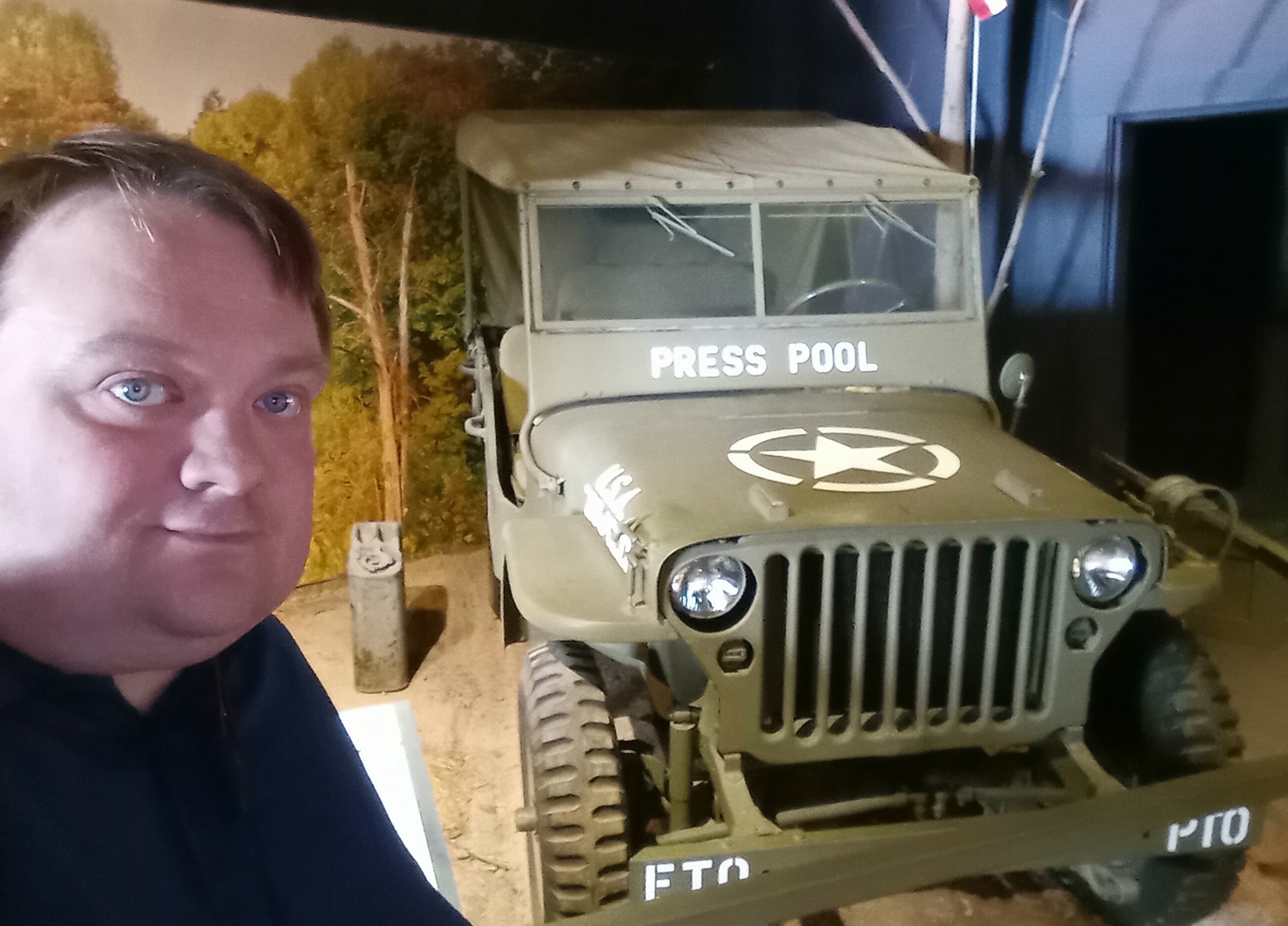
As a journalist, I have found myself interested in journalism history.
As journalists, sometimes we aspire to cover major events in world history. Some of those events, like World War II, are unplanned – and such assignments can be dangerous.
Ernie Pyle of Dana, Indiana paid the ultimate sacrifice for his country, and in the name of journalism.
Pyle (no relation to the fictional Marine Corp. character of Gomer Pyle) wrote for Scripps-Howard, and reported from both the European and Pacific theaters. He was killed by enemy fire on April 18, 1945 while reporting from the Battle of Okinawa.
Technological advances will soon make it so much easier to report from the front lines, with much better logistics than the previous World War. Pyle’s experiences remind us of how it was done “by hand,” the “old-fashioned way.” The skillset was much different then. World War II also gave stateside an inside look at how life and times were like at the deadliest of locations, thanks to journalists like Pyle. This wasn’t a thing during World War I. The piquing of curiosities through radio and television to a world around us brought more enterprise reporting to newspapers and other print publications. Pyle’s stories were very compelling now, and they remain very compelling today – and perhaps will be even more compelling as life evolves.

Pyle was born in 1900 on a farm south of town. The house was moved to its present site in town long after his death and is now one of two parts of the museum. The interior has been restored to the Pyle Family period, and tours are led by a docent. The living room, bedroom and kitchen are three of the rooms, with stories of family life and what life was like right after the turn of the 20th century being told. Children can be fascinated by a “what’s this” parade of learning about old kitchen equipment and home decor.
After going through the home, the next building is a double-Quonset hut that makes up the journalism and war portion of his career. Prior to covering the war, Pyle worked in local reporting and covered several national aviation stories. He’d soon be on long plane rides himself, first across the Atlantic from 1942-45, and then across the Pacific starting in Jan. 1945.
Several of Pyle’s human interest stories are told through signs and historical dioramas, where visitors go on a self-guided tour. Artifacts from his work – utensils, press passes, you name it – are found in pull-out shelving displays. Videos of his life and times are at the front and back of the building. A gift shop is at the end of the tour.

Ernest Taylor “Ernie” Pyle became famous for writing about the experiences of ordinary soldiers rather than military leaders during World War II. He first gained national recognition in the 1930s as a roving human-interest columnist for the Scripps-Howard, with his pieces appearing in hundreds of newspapers. After the United States entered the war, Pyle applied a folksy, personal style to battlefield reporting in both the European and Pacific theaters; he covered campaigns in North Africa, Italy and France. He earned the Pulitzer Prize for distinguished correspondence in 1944. In 1945 Pyle traveled to the Pacific to chronicle the fight against Japan, but was killed by enemy fire on the island of Iejima during the Battle of Okinawa. At the time of his death he was one of the best-known American war correspondents, and President Harry S. Truman praised him for telling the story of the American fighting man as those men wanted it told.
Human interest reporting grew in the 1940s with the advances of media at the time. It was one thing to hear facts and figures, but another to take in the personal stories of individuals doing the grunt work. They were “fighting,” but how were they doing it? What is going through their mind as they are doing that? What did they personally feel about doing what they were doing? How atrocious did they consider the actions of Nazi Germany? That’s what a human interest reporter aims to write about – and in a way, brings one’s “Dear spouse” letter to the public arena.
There’s also the behind-the-scenes side of journalism that readers do not see: How the news is gathered, going through command’s red tape, what’s “on” or “off” the record, dealing with editors, etc. The museum’s exhibits also present a look at how journalism is done.
I took note of one of the stories on one of the signs. Here’s a glimpse of what kind of reports Pyle would write for the readers back home:

This is an edited photo (here is the original)
Human interest reporting will never fade as long as the DNA of every human is different. If you’re a journalist who is looking to expand their resume, I suggest this as a road trip stop to expand your horizons. Even if you’re not a journalist, the museum provides a glimpse of life rarely documented.
There isn’t much else in Dana. An old bank building stands with its usual column-based design. Old buildings have seen better days. There is a pizza place outside of town at the intersection of U.S. Route 34 and Indiana Route 71. Charlie’s Pizza can be found at the sight of a replica spaceship capsule. As if Charlie’s delivers to outer space!
This trip to the Ernie Pyle Museum was a side adventure on my Illinois Route 1 trip in Fall 2025. Dana is about 10 miles east of Route 1 and Chrisman, home to a Frostop Root Beer stand.
Ernie Pyle World War II Museum
120 Briarwood Ave, Dana, IN
Open 10 a.m. to 5 p.m. Friday and Saturday, noon to 5 p.m. Sunday – March to November
Erniepyle.com; (765) 665-3633
Admission: free, donations encouraged
***
I conclude with a note about this website. As I was uploading the pictures onto the photo album, I noticed that I took about 40 pictures of everything I found interesting. I realized that if I uploaded all of these pictures onto a photo album, it will make readers feel like they are seeing everything that’s there, and thus they are not likely to actually go on the road to visit these places. I kept my picture count to 10 on the museum itself. If you ever go through the photo albums and wonder why I don’t take a lot of pictures of every place I go to, this is why. I would much rather have you travel and visit – and see with your own two eyes, and hear with your own two ears from the knowledgeable docents – than get everything you need from me. I simply bring you awareness of places, it’s up to you to determine if you want to take the trip to learn more – and when you do, please consider making a donation.
 Cody’s Road Trips