
MINERAL, Ill. – As I’m typing this post (Feb. 12), most of northwest Illinois is under a winter weather advisory, with a large blanket of snow finally arriving after a relatively mild winter.
Upon hearing that a large amount of snow was going to come, I felt like I needed to get one more outdoor road trip in before it was too late. I didn’t go too far from home, just about 30 miles south-southwest, but it felt good to get away from the house after a long period of magazine work.
Mineral, a small town in western Bureau County, wound up being my destination on Feb. 11. I enjoyed the scenic drive down, stopped at a couple of Mineral things, and ate at the Purple Onion in nearby Annawan. It was a relatively light trip, but it felt good to be wandering on the open road agin.
The western and southern parts of Bureau County are really scenic. I wrote about one particular area about a year ago. What makes it interesting is that these two areas once were part of the ancient Lake Milan (retroactively named by geologists) and part of the ancient path of the Mississippi River. The “Mighty Mississip'” didn’t always go through the Quad Cities, Burlington and Quincy; up until about 20,000 years ago, the river went from Albany to Hennepin, and then south along today’s Illinois River to Grafton. I shared a journey of that path on my Facebook page, and I’ll have to repost it here sometime soon.
The ancient Mississippi River path crossed, and eventually Lake Milan settled on, the area north of Mineral and south of Thomas (an even tinier town at a T intersection without a town sign). Further geological evolution created the current Mississippi River path through the Quad Cities and dried up Lake Milan. Some sand deposits from the lake remained and formed large hills in this area.

Between Albany and Hennepin, the largest collection of sandy hills centers around the McCune Sand Prairie, located on County Highway 10 between Thomas and Mineral. While other square miles around it have since been converted into farmland, this 200-acre area named after former landowners has been left largely intact since the earliest White settlers came in the early 1830s. Plenty of slopes and vegetation make up the area that’s topped by a sandy surface. Some of the nearby sand hills go high enough that they were altered when roads were built.
The area has a couple of faint, not-so-obvious-looking hiking trails going up and down slopes. A visit there will also make one come in contact with cacti. No, not the tall types with two arms one would find in the southwest desserts, but flat prickly pear ones that look like an oven mitt with spikes on it (the photo at the top of the post was taken when I visited in 2020). Since many farms are around it, the area’s untouched vegetation also is a haven for birds and animals who enjoy finding someplace cozy.
Also nearby is the Mineral Marsh Nature Preserve, a couple of miles to the west. The marshland also serves as a reminder of the lake that once was there.
Even if flora and fauna are not your thing, the visuals of the topography is something still interesting to see.
If you didn’t know that cacti could grow in Illinois, now you do. At least a small version of it does.
In town(s)
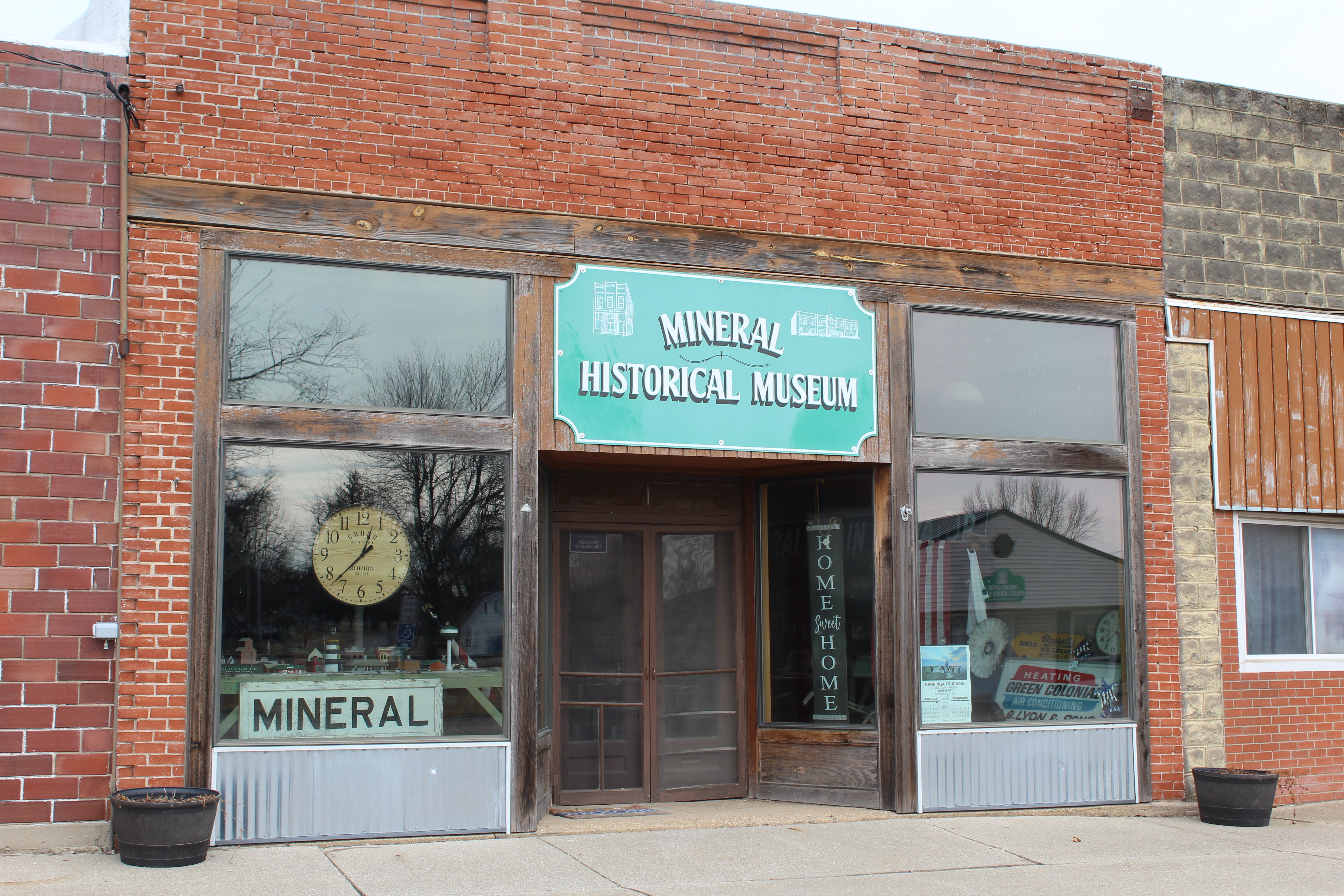
Mineral is where my friend Dave grew up, and he has done a lot to preserve much of the town’s history and schooltime “Glory Days” (posts on that will be coming soon!) A cousin of mine also briefly lived here. In summary, the town of 200 has a historical museum, monument to mark where the school once was, an old cupola style grain elevator for the Iowa Interstate railroad (formerly the Rock Island line), the Wagon Wheel bar and grill, and baseball fields – the back of one of the storage rooms behind home plate has a mural of a leopard in green and white colors. This pays homage to the school’s former nickname, the Leopards.
Going west out of town toward Annawan on U.S. Route 6 sends motorists over King Creek. The highway parallels the railroad line. On the opposite side of the railroad once was the main road through town, replaced by the paved highway in the 1920s. A small pony truss bridge on this road remains, crossing King Creek, but has been closed to traffic for several years. East of town, the road crossed the railroad in a short stair-step jog three miles away (this is now a private driveway).

Stopped at the Purple Onion in downtown Annawan for lunch. Kids from Mineral now attend school in Annawan. The restaurant is one of those that has the old rectangular red-white-blue backlit Pepsi signs out front. Back when they were commonplace, such signs were simply to inform people of the business; now, I consider them to be gem-finds of nostalgia. The restaurant serves the usual fare, specials, and $0.50 baked cookies. For those who can’t sit on bar stools but prefer the bar counter over a table, its purple counter is ADA compliant with standard chairs.
It was a short trip, but well worth it since I got something in before all of the snow fell. I don’t like traveling to outdoor spots when there’s snow on the ground, except if it’s a big part of the attraction. I’ll have to wait until the snow melts before I go traveling again.
 Cody’s Road Trips